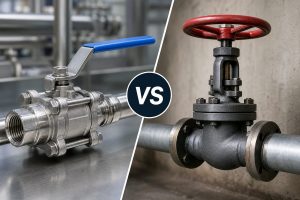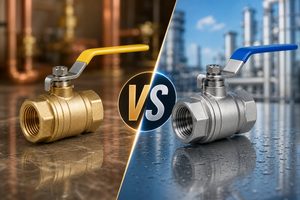
Resumo rápido
Uma válvula de retenção impede o refluxo da contrapressão, mas não impede a contra-sifonagem. Um disjuntor de vácuo pára a contra-sifonagem (condições de vácuo) mas não pára a contrapressão. A utilização dos dois dispositivos em conjunto proporciona-lhe uma proteção completa.
Está no corredor da canalização da sua loja de ferragens local. Precisa de um dispositivo que impeça a água de correr para trás. Mas há duas opções à sua frente: um quebra-vácuo e uma válvula de retenção.
Escolher a opção errada pode contaminar a água potável. Ou danificar o seu equipamento. Ou falhar uma inspeção de canalização.
Como profissional fabricante de válvula de retenção, Por isso, elaborei este guia completo sobre o debate entre o quebra-vácuo e a válvula de retenção. Quando terminar de ler, saberá exatamente qual o dispositivo que deve estar no SEU sistema.
Vamos mergulhar no assunto.
O que é uma válvula de retenção? (A explicação simples)
Uma válvula de retenção faz uma coisa. E fá-lo bem.
Permite que o fluido entre apenas uma direção.
Pense nisso como um segurança num clube exclusivo. A água pode entrar. Mas não pode voltar a sair.
Eis como funciona:
No interior da válvula, existe um disco, uma esfera ou uma aba. Quando a água flui no sentido correto, a pressão empurra esse componente interno para o abrir. O fluido passa através dele. Não há problema.
Mas quando o fluxo tenta inverter-se? Essa mesma pressão empurra o disco ou a esfera de volta para a sua sede. A válvula fecha-se. O refluxo pára imediatamente.
As válvulas de retenção funcionam automaticamente. Sem interruptores manuais. Sem eletricidade. Apenas uma mecânica simples e fiável.
Tipos comuns de válvulas de retenção
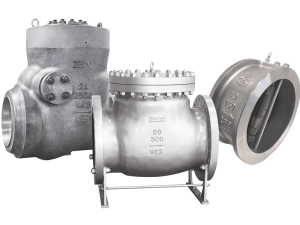
Válvulas de retenção oscilantes - Estes têm uma porta articulada que se abre com o fluxo para a frente. Quando o fluxo pára, a gravidade fecha a porta. Ótimo para sistemas de baixa pressão. Não são ideais para aplicações de alta velocidade (podem causar golpes de aríete).
Válvulas de retenção de esfera - Uma bola fica no interior da câmara. O fluxo para a frente empurra a esfera para fora do seu assento. O fluxo inverso empurra-a de volta. Super fiável. Funciona com líquidos que contenham sólidos.
Válvulas de retenção de mola - Uma mola mantém o disco fechado até que a pressão se acumule. Quando a pressão atinge a “pressão de fissuração”, a mola comprime-se e o fluxo começa. Quando a pressão diminui, a mola empurra o disco de volta para o sítio. Tempo de resposta rápido. Perfeito para sistemas com pressão flutuante.
Válvulas de retenção de elevação - O disco move-se verticalmente para cima e para baixo. Funciona bem em aplicações de alta pressão. Necessita de mais manutenção do que outros tipos.
Dica profissional: Se estiver a trabalhar com uma bomba de drenagem ou um sistema de aquecimento, uma válvula de retenção é normalmente a sua melhor aposta. Mais sobre isso num minuto.
O que é um disjuntor de vácuo? (e porque é que pode precisar de um)
Um quebra-vácuo resolve um problema diferente.
Evita sifonagem de retorno.
Eis o que isso significa:
Digamos que tem uma mangueira de jardim ligada a uma torneira exterior. O bocal da mangueira está num balde de água com sabão. De repente, a pressão da água principal cai (talvez um camião de bombeiros tenha acabado de abrir uma boca de incêndio ao fundo da rua).
Essa queda de pressão cria uma vácuo na sua linha de água.
E esse vácuo pode chupar a água com sabão do balde... de volta através da mangueira... e para o abastecimento de água potável da sua casa.
Que nojo. E perigoso.
Um disjuntor de vácuo impede que isso aconteça, deixando entrar ar na linha no momento em que detecta um vácuo. O ar entra na linha. O vácuo quebra-se. Sem sifão. Sem contaminação.
Tipos de Vacuum Breakers
Disjuntor a Vácuo Atmosférico (AVB) - O tipo mais simples. Abre-se automaticamente quando detecta uma pressão negativa. Barato e eficaz. Mas não pode suportar uma pressão contínua. Deve ser instalado acima do ponto mais alto do sistema.
Disjuntor de pressão e vácuo (PVB) - Mais robusto. Utiliza uma válvula de retenção com mola. Pode suportar pressões mais elevadas. Inclui válvulas de teste para que possa verificar se está a funcionar corretamente. Comum em sistemas de rega.
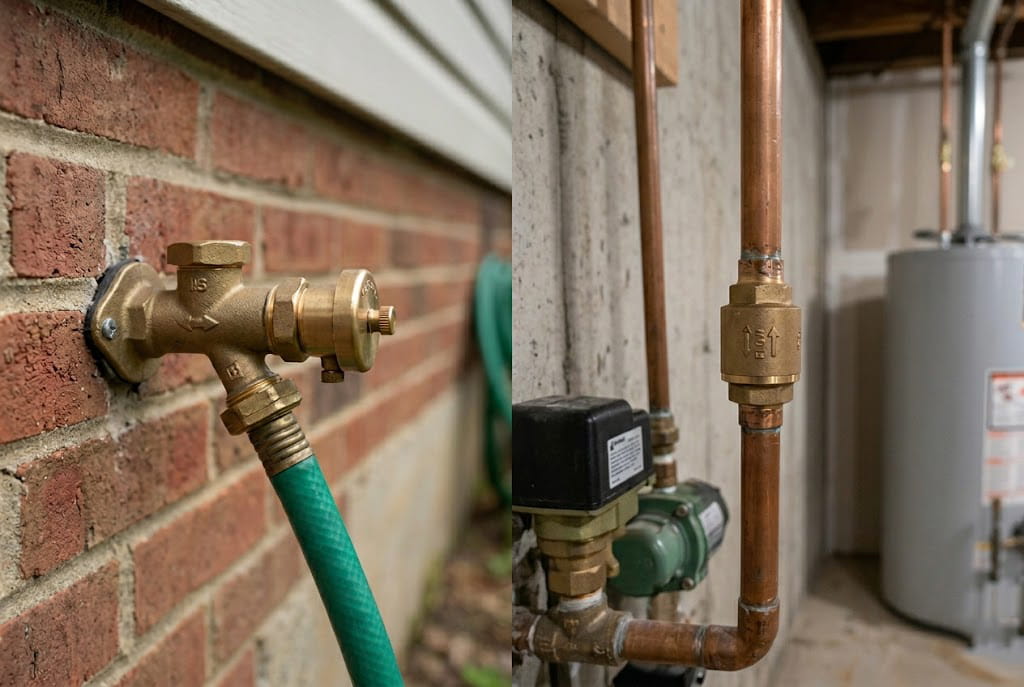
Disjuntor de vácuo para mangueira - Aparafusa-se diretamente a uma torneira exterior. Provavelmente já os viu - são os pequenos acessórios de latão que, por vezes, deixam escapar um pouco de água quando se fecha a mangueira. Exigido por lei na maioria das torneiras exteriores.
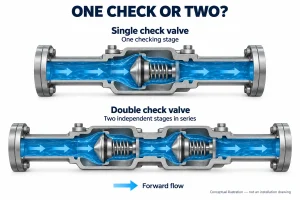
Conjunto de válvula de retenção dupla (DCVA) - Duas válvulas de retenção em série. Se uma falhar, a outra continua a impedir o refluxo. Utilizadas em aplicações de risco moderado, como edifícios comerciais.
Vacuum Breaker vs. Válvula de retenção: As diferenças críticas
É aqui que as coisas ficam interessantes.
À primeira vista, estes dispositivos parecem semelhantes. Mas funcionam em princípios completamente diferentes.
Deixem-me explicar-vos:
| Recurso | Disjuntor a vácuo | Válvula de retenção |
|---|---|---|
| Função principal | Quebra o vácuo para parar a sifonagem | Evita o refluxo |
| Como funciona | Vamos respirar para dentro da linha | Cria uma vedação unidirecional |
| Protege contra | Sifonagem de retorno (vácuo) | Contrapressão E contra-sifonagem |
| Localização típica | Em potenciais pontos de ligação cruzada | Em todos os sistemas de tubagem |
| Código exigido em | Válvulas de mangueiras, de irrigação e de descarga de sanitas | Bombas, sistemas de aquecimento, linhas de drenagem |
O resultado final?
A válvula de retenção impede que a água flua para trás em QUALQUER condição - quer se trate de contrapressão OU de sifonagem.
A quebra-vácuo Protege APENAS contra a retro-sifonagem causada por um vácuo. Não impede a contrapressão.
Mas eis o que a maioria das pessoas não vê:
Nalguns cenários, um quebra-vácuo é, na verdade, considerado um tipo especializado de válvula de retenção. Ambas utilizam vedantes unidireccionais. Mas são não permutáveis para cada aplicação.
Dica profissional: Se está a proteger o seu abastecimento de água potável, verifique o código de canalização local. Muitas jurisdições exigir disjuntores de vácuo em torneiras exteriores e sistemas de irrigação. Uma válvula de retenção por si só não passa na inspeção.
Aplicações do mundo real: Onde cada dispositivo se destaca
Deixem-me dar-vos alguns exemplos concretos. Porque a teoria é óptima. Mas é preciso saber o que realmente funciona no mundo real.
Quando utilizar uma válvula de retenção
Bombas de depósito - A bomba de drenagem empurra a água para fora da cave e para um tubo de descarga. Sem uma válvula de retenção, essa água flui diretamente para o poço de drenagem depois de a bomba se desligar. A bomba liga-se e desliga-se constantemente. Queima-se mais depressa. Uma simples válvula de retenção com mola resolve este problema.
Sistemas de aquecimento - As caldeiras e os sistemas de aquecimento hidrónico utilizam válvulas de retenção para manter a água a circular na direção correta. Evita que o calor migre para onde não deve.
Tratamento de água - Não se quer que a água tratada volte a fluir para o abastecimento não tratado. As válvulas de retenção criam uma interrupção limpa.
Proteção da bomba - Coloque uma válvula de retenção no lado de descarga de qualquer bomba. Esta evita o refluxo que pode fazer girar a bomba para trás e danificar o impulsor.
Quando utilizar um interrutor de vácuo
Mangueiras de jardim - Este é o grande problema. Um disjuntor de vácuo para tubo flexível custa cerca de $10. Impede que a água contaminada volte a entrar na canalização da sua casa. Código exigido na maior parte das zonas.
Sistemas de irrigação - As linhas de aspersão ficam debaixo da terra. Podem acumular fertilizantes, pesticidas e bactérias. Um quebra-vácuo de pressão garante que nada disso é sugado para o abastecimento de água principal.
Sistemas de descarga para sanitas de veículos de recreio - Eis um exemplo do mundo real que vejo a toda a hora. Os fabricantes de veículos de recreio instalam disjuntores de vácuo nos sistemas de descarga de água negra. Mesmo que se usem mangueiras separadas, o vácuo pode aspirar a água contaminada para trás. O dispositivo de proteção contra o vácuo evita que isso aconteça.
Máquinas de lavar loiça comerciais - Evita que a água suja seja sugada de volta para a linha de água potável durante uma queda de pressão.
Estudo de caso: Por que é que o aspirador de pó de um leitor continuava a ter fugas
Recentemente, tive conhecimento de um leitor com uma caravana Thor Freedom Elite de 2019.
Ele tinha uma fuga no seu disjuntor de vácuo San-T-Flush. Por isso, comprou um de substituição. Instalou-o.
Também vazou.
Frustrante, não é?
Eis o que estava a acontecer:
O quebra-vácuo só tem fugas quando o San-T-Flush está em funcionamento. Na verdade, esse é um comportamento normal. A maioria dos disjuntores de vácuo tem uma pequena abertura que liberta água em determinadas condições. Mas no caso dele, a fuga era enérgico - e não um gotejamento lento.
Depois de investigar, apercebemo-nos de que o problema não era o disjuntor de vácuo em si. O problema era a pressão a montante. O sistema estava a registar uma pressão superior à que o disjuntor de vácuo foi concebido para suportar.
A solução? Ele instalou um regulador de pressão antes do disjuntor de vácuo. Problema resolvido.
A lição a tirar daqui: Verificar sempre a pressão do sistema antes de culpar o aparelho. A quebra-vácuo vs válvula de retenção O problema raramente tem a ver com a válvula em si - tem a ver com o ajuste da aplicação.
É possível usar os dois? (Spoiler: Sim)
Eis uma pergunta que me fazem muitas vezes:
“Preciso de um quebra-vácuo OU de uma válvula de retenção? Não posso escolher apenas uma?”
É absolutamente possível utilizar ambos no mesmo sistema.
De facto, esta é muitas vezes a melhor abordagem.
Deixem-me explicar:
Uma válvula de retenção impede o refluxo devido a contrapressão. Um disjuntor de vácuo impede o refluxo devido a uma sifonagem de retorno. Se instalar apenas um, está apenas meio protegido.
Por exemplo, digamos que está a canalizar água fria subterrânea da sua casa para uma boca de incêndio exterior. O ponto de ligação é o ponto mais baixo do ramal (para o poder drenar no inverno).
A quebra-vácuo Só por si não impede que a água entre em casa se a pressão cair. Mas um válvula de retenção só por si não protege contra a sifonagem.
A solução?
Instale ambas. Uma válvula de retenção de 3/4″ não custa quase nada. O mesmo acontece com um disjuntor de vácuo. Em conjunto, obtém proteção completa.
Dica profissional: Alguns dispositivos modernos combinam ambas as funções numa única unidade. Procure uma “válvula de retenção com quebra-vácuo” se pretender uma solução tudo-em-um.
O que diz o código de canalização?
Não sou advogado. E os códigos variam consoante o local.
Mas a regra geral é a seguinte:
É OBRIGATÓRIO o uso de disjuntores de vácuo sobre:
- Bicos de mangueiras exteriores (disjuntores de vácuo para bicos de mangueiras)
- Sistemas de irrigação (pressurizadores de vácuo)
- Válvulas de descarga de sanitas (especialmente aplicações comerciais e de veículos de recreio)
- Torneiras de laboratório
- Equipamento dentário
As válvulas de retenção são RECOMENDADAS sobre:
- Linhas de descarga da bomba de drenagem
- Linhas de alimentação da caldeira
- Reservatórios de expansão do aquecedor de água
- Sistemas de bombagem de poços
- Qualquer descarga da bomba
Se não tiver a certeza, contacte o departamento de construção local. Um telefonema de cinco minutos pode salvá-lo de uma inspeção falhada (ou pior - água contaminada).
Como escolher: Um quadro de decisão simples
Eis o meu processo simples em 3 passos para escolher entre um quebra-vácuo vs válvula de retenção:
Passo 1: Identificar o seu risco
Está a proteger a água potável da contaminação? Isso é uma quebra-vácuo situação.
Está a proteger o equipamento contra danos causados por refluxos? Isso é uma válvula de retenção situação.
Passo 2: Verificar a fonte de pressão
É possível a ocorrência de refluxo de sifonagem (como uma queda de pressão na linha principal)? Disjuntor de vácuo.
É possível uma contrapressão (como uma bomba que empurra a água para trás)? Válvula de retenção.
Passo 3: Ler o código
Algumas aplicações EXIGEM dispositivos específicos. Não adivinhe. Procure.
Ainda não tem a certeza? Opte por ambos. É um seguro barato.
Erros comuns que vejo (e como evitá-los)
Depois de ajudar os leitores com problemas de canalização durante anos, reparei nos mesmos erros vezes sem conta:
Erro #1: Utilizar uma válvula de retenção numa torneira de mangueira exterior
Não passa o código. Não protege contra sifonagem. Em vez disso, utilize um disjuntor de vácuo para tubo flexível.
Erro #2: Instalar um disjuntor de vácuo num sistema de pressão contínua
Os disjuntores de vácuo atmosféricos não aguentam uma pressão constante. Terão fugas ou falharão. Utilize um quebra-vácuo de pressão (PVB) ou um conjunto de válvula de retenção dupla.
Erro #3: Ignorar a orientação
As válvulas de retenção têm uma direção de fluxo marcada. Se as instalar ao contrário, não funcionam. Os disjuntores de vácuo também têm requisitos de orientação - especialmente os AVB (devem estar acima do ponto mais alto).
Erro #4: Comprar válvulas baratas sem nome
Eu percebo. Poupar dinheiro é bom. Mas um desconector avariado pode pôr a sua família doente. Gaste o $5 extra numa unidade de latão de uma marca conceituada.
O resultado final sobre o Disjuntor de vácuo vs Válvula de retenção
Eis o que quero que recordem:
A válvula de retenção impede o refluxo da contrapressão. É um portão de sentido único. Perfeito para bombas, sistemas de aquecimento e linhas de drenagem.
A quebra-vácuo Impede o refluxo de sifonagem. Permite a entrada de ar na linha para quebrar o vácuo. Necessário em bicos de mangueira, irrigação e qualquer ligação de água potável que possa ser submersa.
Não são iguais. Não são intermutáveis. Mas são funcionam muito bem em conjunto.
Ainda estou a tentar decidir entre um quebra-vácuo vs válvula de retenção para o seu projeto específico? Deixe um comentário abaixo com a sua configuração. Eu leio cada um deles.
E se achou isto útil, partilhe-o com alguém que esteja confuso no corredor da canalização. Mais tarde vão agradecer-lhe.