Résumé rapide
Les robinets-vannes conviennent mieux aux liquides propres, aux opérations peu fréquentes et aux pertes de charge minimes, mais ils ne doivent jamais être utilisés pour l'étranglement. Les robinets à tournant conique sont excellents pour les boues, l'action rapide d'un quart de tour et la fermeture étanche, bien qu'ils nécessitent des exercices périodiques pour éviter le collage. Choisissez en fonction de vos besoins en termes de fluide, de fréquence des cycles et de vitesse.
Lorsque vous concevez un système de contrôle des fluides, c'est peut-être pour une usine chimique ou une installation de traitement des eaux usées. Deux options s'offrent à vous : un robinet-vanne et un robinet à boisseau conique.
Lequel choisissez-vous ?
Si vous choisissez la mauvaise vanne, vous devrez faire face à des fuites, à des composants bloqués et à des temps d'arrêt coûteux.
Mais une fois que l'on a compris quelques différences essentielles, le choix devient évident.
Dans ce guide, en tant que professionnel fabricant de robinet-vanne, Je vais vous montrer exactement comment robinet-vanne et robinet à boisseau conique tombe en panne. Nous aborderons la vitesse de fonctionnement, la capacité d'étanchéité, la maintenance et les applications réelles.
À la fin de votre lecture, vous saurez exactement quelle valve doit être utilisée dans votre système.
Plongeons dans le vif du sujet.
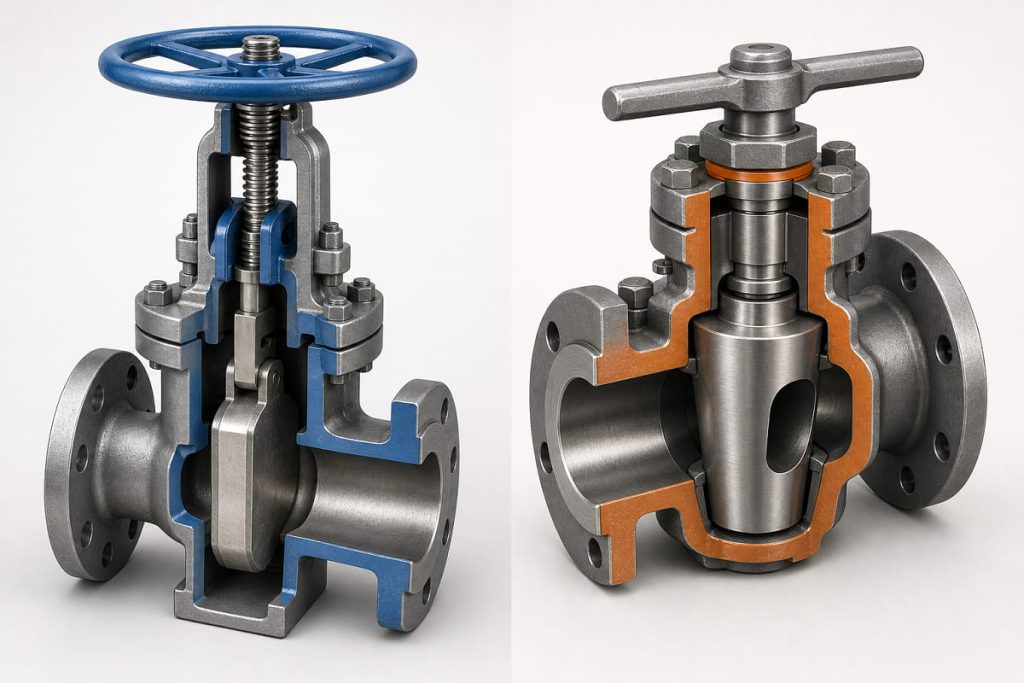
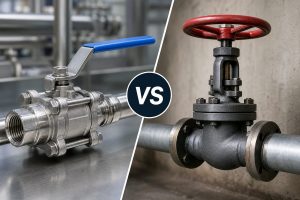
Quelle est la grande différence entre ces deux vannes ?
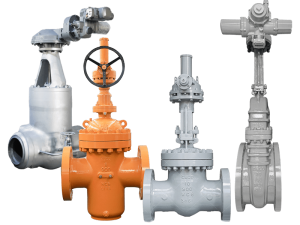
A vanne à opercule utilise une porte coulissante pour bloquer le flux. Pensez-y comme à un pont-levis. Lorsqu'il est en position haute, le flux circule librement. Lorsqu'il est abaissé, le flux s'arrête complètement.
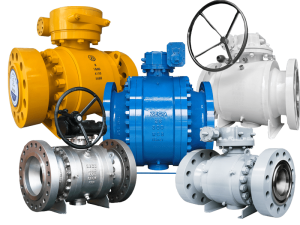
A robinet à tournant sphérique utilise un bouchon conique ou cylindrique percé d'un trou. Il suffit de le tourner d'un quart de tour pour que le trou s'aligne sur le tuyau. L'écoulement se produit. Si vous le tournez en sens inverse, la partie solide du bouchon bloque tout.
C'est simple, non ?
Mais le diable se cache dans les détails.
Permettez-moi de détailler chaque type de soupape afin que vous puissiez comprendre ce que je veux dire.
Robinets-vannes : Le cheval de trait lent et stable
Les robinets-vannes existent depuis toujours. Et pour cause.
Comment ils fonctionnent :
Vous tournez un volant. Plusieurs fois. La tige tourne, ce qui fait monter ou descendre l'opercule à l'intérieur du corps de vanne.
Lorsque la vanne est entièrement relevée ? Vous obtenez ce que l'on appelle un “full bore”, c'est-à-dire que le tuyau est complètement ouvert. Pas d'obstructions. Pas de chutes de pression bizarres.
Lorsqu'elle est complètement abaissée ? La porte bloque complètement le flux.
Voici ce que j'aime dans les robinets-vannes :
- Résistance minimale à l'écoulement - Lorsqu'elle est complètement ouverte, c'est comme si la valve n'était pas là.
- Bidirectionnel - Fonctionne de la même manière quel que soit le sens d'écoulement
- Bonne résistance à la haute pression - La conception de la cale crée un joint mécanique solide
Mais il y a de sérieux inconvénients :
- Fonctionnement lent - La multiplicité des tours signifie que vous n'ouvrirez pas cette chose rapidement
- Mauvais pour l'étranglement - N'utilisez jamais un robinet-vanne pour contrôler partiellement le débit. La vanne vibrera. Les sièges s'usent. Vous le regretterez.
- La tige se trouve sur le trajet de l'écoulement - Ce qui signifie plus de corrosion et d'usure au fil du temps
Conseil de pro : Les robinets-vannes sont conçus pour une SEULE chose : l'ouverture ou la fermeture complète. C'est tout. N'essayez pas de faire preuve de fantaisie avec eux.
Robinets à soupape : Le quart de tour à tirage rapide
Parlons maintenant des vannes d'obturation.
Comment ils fonctionnent :
Une vanne à clapet utilise un clapet cylindrique ou conique percé d'un trou. Vous tournez le clapet de 90 degrés - c'est tout. Un quart de tour, et vous êtes soit complètement ouvert, soit complètement fermé.
Pourquoi les gens aiment les vannes à clapet :
- Fonctionnement rapide - Ce quart de tour permet d'ouvrir ou de fermer en moins d'une seconde.
- Idéal pour les boues - L'action d'essuyage du bouchon élimine les débris pendant qu'il tourne.
- Fermeture étanche - Versions spécialement lubrifiées, permettant d'obtenir une étanchéité à la bulle.
- Design compact - Moins encombrant qu'un robinet-vanne (bien que la poignée puisse être longue)
Les moins bonnes choses :
- Couple plus élevé - Les robinets à tournant conique peuvent être difficiles à tourner, en particulier sous haute pression.
- Restriction de débit - À moins que vous n'optiez pour un modèle à passage intégral, la plupart des robinets à tournant conique entraînent une perte de pression
- Peut coller - Si vous ne les entretenez pas, ils peuvent devenir impossibles à bouger
J'ai appris cette leçon à mes dépens au début de ma carrière. Un client avait un robinet d'arrêt qui n'avait pas été touché depuis trois ans. Lorsqu'il a essayé de le fermer en cas d'urgence ? Rien. Il est resté bloqué.
Ne vous laissez pas faire.
Différences essentielles : Robinet-vanne et robinet à boisseau conique Tête à tête
Permettez-moi d'expliquer cela d'une manière facile à assimiler.
| Fonctionnalité | Vanne à guillotine | Vanne à boisseau |
|---|---|---|
| Opération | Multi-tour (lent) | Quart de tour (rapide) |
| Trajet d'écoulement | Alésage complet (sans restriction) | Alésage généralement réduit |
| Meilleur pour | Liquides propres, haute pression | Boues, gaz, cycles fréquents |
| Étranglement? | Jamais | Les versions à port diamant peuvent |
| Entretien | Modéré | Faible (si lubrifié) |
| Espace nécessaire | Plus (surtout la tige montante) | Moins |
Mais voilà, ce tableau ne vous donne qu'une partie de l'histoire.
Permettez-moi de vous présenter quelques scénarios concrets.
Quand choisir un robinet-vanne ?
D'après l'expérience que j'ai acquise en travaillant sur des centaines de systèmes industriels, les robinets-vannes se révèlent efficaces dans des situations spécifiques.
1. Vous avez besoin d'une perte de charge minimale
Si vous déplacez de grands volumes de liquide et que vous ne pouvez pas vous permettre de perdre de l'énergie, la conception à passage intégral d'un robinet-vanne est votre meilleure alliée. Les usines de traitement de l'eau utilisent des robinets-vannes exactement pour cette raison.
2. Le robinet ne fonctionne pas souvent
Les robinets-vannes sont conçus pour une utilisation peu fréquente. Ils resteront en place pendant des années, entièrement ouverts ou entièrement fermés, et fonctionneront parfaitement lorsque vous en aurez besoin.
3. Vous avez affaire à une pression et à une température élevées.
Les robinets-vannes résistent mieux aux conditions extrêmes que les robinets à tournant conique. La conception du coin crée un joint mécanique fiable qui ne dépend pas d'élastomères susceptibles de se dégrader.
4. Vous avez besoin d'une vanne de grand diamètre
Au-delà de 12 pouces, les robinets-vannes deviennent plus pratiques et plus rentables que les robinets à tournant conique.
Exemple concret : Une centrale électrique pour laquelle j'étais consultant utilisait des robinets-vannes de 24 pouces sur ses principales conduites de vapeur. Ces vannes étaient en service depuis 15 ans. Elles fonctionnaient toujours à merveille.
Quand choisir un robinet à boisseau conique ?
Les vannes à clapet ont leur propre point d'équilibre.
1. Vous avez besoin d'un fonctionnement rapide
Arrêt d'urgence ? Cyclages fréquents ? Cette opération d'un quart de tour change la donne.
2. Vous manipulez des boues ou des fluides abrasifs.
L'action rotative du bouchon a un effet autonettoyant. Il essuie littéralement les débris au fur et à mesure qu'il tourne. Vannes à guillotine ? Les débris s'accumulent dans le fond, empêchant une fermeture complète.
3. L'espace est restreint
Les robinets à tournant conique sont compacts. Si votre installation dispose d'un espace limité, en particulier au-dessus du robinet (où les robinets-vannes à tige montante ont besoin d'espace), un robinet à boisseau conique est la solution.
4. Vous avez besoin d'une fermeture étanche pour les gaz
Les robinets à tournant conique lubrifiés peuvent assurer une étanchéité à la bulle parfaite pour les systèmes à gaz.
Exemple concret : Une société de distribution de gaz naturel a remplacé les robinets-vannes par des robinets à boisseau sur ses lignes principales. Les appels de maintenance ont diminué de 60% car les robinets à boisseau ne se grippaient pas comme le faisaient les robinets-vannes.
Parlons de la limitation du débit
C'est là que les gens s'embrouillent.
Les vannes à guillotine, lorsqu'elles sont complètement ouvertes, n'offrent pratiquement aucune restriction de débit. La vanne se soulève complètement pour ne pas gêner le passage. C'est un passage direct.
Valves à bouchon ? La plupart d'entre eux ont un orifice réduit. L'ouverture à travers le clapet est plus petite que le diamètre du tuyau. Cela crée une certaine perte de charge.
Mais voici ce que la plupart des gens ne réalisent pas :
Il existe des vannes d'obturation à passage intégral. Ils coûtent plus cher, mais ils éliminent le problème de la restriction du débit.
Ainsi, si vous aimez tout ce qui concerne les vannes à clapet, mais que vous vous inquiétez de la perte de charge, il vous suffit de spécifier un modèle à passage intégral. Le problème est résolu.
Maintenance : Quelle valve provoque le moins de maux de tête ?
Permettez-moi d'être franc avec vous.
Problèmes de maintenance des vannes :
- La tige se trouve dans la trajectoire du flux, elle se corrode donc
- Des débris peuvent s'accumuler dans le fond, empêchant une fermeture complète.
- La garniture autour de la tige finit par fuir
- Les sièges s'usent, surtout si l'on utilise accidentellement la valve pour l'étranglement.
Problèmes d'entretien des vannes d'obturation :
- Peut devenir impossible à tourner s'il n'est pas utilisé régulièrement
- Les versions lubrifiées nécessitent... une lubrification.
- Le bouchon peut frotter contre le corps en cas de service à haute température.
Qu'est-ce qui est le mieux ?
Pour les services propres où les cycles de la vanne sont peu fréquents ? Les robinets-vannes nécessitent moins d'entretien.
Pour les services sales où les cycles de la vanne sont fréquents ? Les vannes à clapet sont gagnantes. Veillez simplement à les exercer périodiquement.
Conseil de pro : Quelle que soit la valve choisie, établissez un calendrier d'entretien. Et respectez-le. Vous vous en féliciterez à l'avenir.
Peut-on mettre les gaz avec ces soupapes ?
Réponse courte : Robinets à soupape ? Non. Les robinets à tournant conique ? Parfois.
Je m'explique.
Les robinets-vannes ne doivent JAMAIS être utilisés pour l'étranglement. Lorsque la vanne est partiellement ouverte, le fluide s'écoule autour d'elle à grande vitesse. Cela provoque :
- Vibrations
- Érosion du siège
- Défaillance prématurée
J'ai vu des robinets-vannes détruits en quelques semaines parce que quelqu'un avait essayé de les utiliser pour contrôler le débit. Ne le faites pas.
Valves à bouchon ? Les robinets standard ne sont pas non plus très efficaces pour l'étranglement. Toutefois, certains fabricants proposent un modèle de clapet à “orifice en diamant” spécialement conçu pour réguler le débit. L'ouverture en forme de diamant permet de mieux contrôler les positions partielles.
Si vous avez besoin d'une véritable capacité d'étranglement, aucune de ces vannes n'est idéale. Il est préférable d'opter pour des robinets à soupape ou des robinets à papillon.
Pression et température : Quel robinet gère le mieux les extrêmes ?
Vannes à guillotine : Excellent pour les hautes pressions (jusqu'à 4500 psi dans certains modèles) et les hautes températures (plus de 1000°F avec les matériaux appropriés). La conception simple de la cale est remarquablement robuste.
Robinets à boisseau sphérique : Bon pour les pressions modérées, mais les pressions élevées augmentent considérablement le couple de fonctionnement. Les limites de température dépendent du matériau du joint - non lubrifié Téflon Les manchons atteignent leur maximum aux alentours de 450°F. Les robinets à tournant conique lubrifiés peuvent atteindre des températures plus élevées, mais le lubrifiant peut se dégrader.
Le résultat ? Pour les conditions extrêmes, optez pour un robinet-vanne.
Guide de décision rapide
Vous n'êtes toujours pas sûr ? Répondez à ces questions :
Posez-vous la question #1 : à quelle fréquence allez-vous actionner le robinet ?
- Quotidien ou hebdomadaire → Clapet de fermeture
- Mensuel ou annuel → Vanne
Posez-vous la question #2 : Qu'est-ce qui circule dans le tuyau ?
- Eau propre, huile, vapeur → L'un ou l'autre fonctionne
- Suspensions, boues, particules abrasives → Vanne à clapet
- Gaz nécessitant une fermeture étanche → Robinet à boisseau conique
Posez-vous la question #3 : Avez-vous besoin d'un débit complet ?
- Oui, la perte de charge est critique → Vanne (ou robinet à boisseau conique à passage intégral)
- Non, une certaine perte de charge est acceptable → Robinet à boisseau sphérique
Posez-vous la question #4 : Quel est votre budget pour l'entretien ?
- Travaux continus minimes → Vanne pour des services propres
- Prêt à lubrifier périodiquement → Robinet à boisseau conique
Posez-vous la question #5 : De quel espace disposez-vous ?
- Espace vertical limité → Robinet à boisseau conique (ou robinet-vanne à tige non montante)
- Beaucoup de place → L'un ou l'autre fonctionne
Parlons vrai : N'y pensez pas trop
J'ai vu des ingénieurs passer des semaines à s'interroger sur le choix des vannes.
Voici mon conseil : Si vous déplacez des liquides propres à haute pression et que le robinet n'effectue pas de cycles fréquents, choisissez un robinet-vanne. Si vous déplacez des produits contenant des solides, si vous avez besoin d'un fonctionnement rapide ou si vous souhaitez une fermeture plus étanche, choisissez un robinet à boisseau conique.
C'est aussi simple que cela dans 80% des cas.
L'autre 20% ? Appelez l'ingénieur d'application d'un fabricant. Ils sont littéralement payés pour répondre à des questions comme les vôtres.
Pour conclure
Permettez-moi de vous dire ceci.
Les robinet-vanne et robinet à boisseau conique se résume à trois choses :
- 1. À quelle vitesse devez-vous opérer ? (Rapide = prise, lent = porte)
- 2. Qu'y a-t-il dans votre pipe ? (Propre = porte, sale = bouchon)
- 3. À quelle fréquence l'utiliserez-vous ? (Souvent = fiche, rarement = porte)
Si vous répondez correctement à ces trois questions, vous choisirez à chaque fois la bonne valve.
J'ai vu les deux types de soupapes fonctionner à merveille dans les applications appropriées. Et j'ai vu les deux échouer lamentablement lorsque quelqu'un les a forcés à jouer le mauvais rôle.
Ne soyez pas cette personne.
Adaptez le robinet à la tâche à accomplir. Votre système vous remerciera. Votre équipe de maintenance vous remerciera. Et votre budget vous remerciera certainement.
Maintenant, allez-y et spécifiez quelques valves. Vous avez ceci.