Kurze Zusammenfassung
- Dual check valves are non‑testable and only suitable for low‑hazard situations (e.g., water heaters).
- Backflow preventers (especially RPZ assemblies) are testable, include fail‑safe relief valves, and are required for protecting potable water from contamination.
- If your system connects to drinking water with any contamination risk, use a backflow preventer – not a check valve.
- Always check local codes; most jurisdictions mandate backflow preventers for high‑hazard cross‑connections.
Most people don’t actually know the difference between a dual check valve vs backflow preventer. And that confusion can cost you. Big time.
I’ve talked to dozens of property owners who installed the wrong device. Some got hit with failed inspections. Others? They found out the hard way when contaminated water backed up into their drinking supply.
Heute also, als Profi Hersteller für Rückschlagventile, I’m going to break down genau what separates these two devices and what you need to know to protect your water system.
Lassen Sie uns eintauchen.
Why This Actually Matters
Here’s something most people don’t realize:
Backflow isn’t some rare, freak occurrence.
It happens all the time.
A water main breaks down the street. A fire hydrant opens up. Suddenly, the pressure in your pipes drops, and that standing water in your irrigation line? It gets sucked right back into your home’s drinking water.
Scary, right?
That’s why understanding the Doppelrückschlagventil vs. Rückflussverhinderer decision isn’t just about checking a box for code compliance. It’s about keeping your family or your customers safe.
Let me show you what I mean.
What Is a Dual Check Valve? (The Simple Version)
A dual check valve is exactly what it sounds like.
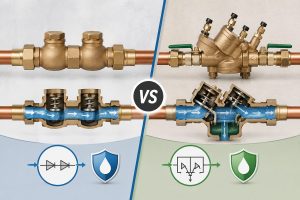
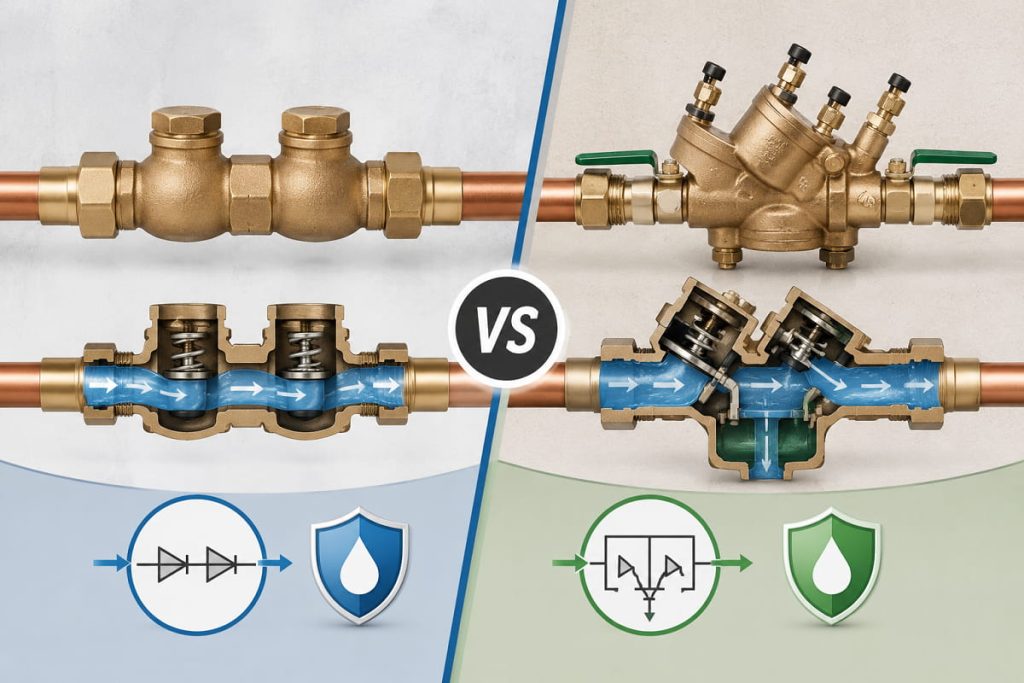
It’s a small, simple device with two independent spring-loaded check valves lined up in a row. That’s it.
When water flows in the right direction, both valves open. When water tries to reverse, they snap shut.
Pretty straightforward.
Where You’ll Find Dual Check Valves
I see these mostly in residential settings. Think:
- Water heater inlets
- Residential service lines
- Druckleitungen für Sumpfpumpen
The key thing to understand? Dual check valves are designed for low-hazard situations.
We’re talking about scenarios where the worst thing that could backflow is some slightly discolored water or a minor aesthetic issue. Not toxic chemicals. Not sewage. Not fertilizer.
The Big Limitation
Here’s where things get tricky.
Dual check valves are non-testable.
That means once they’re installed, there’s no way to know if they’re actually working. A small piece of debris could lodge one of the check valves open, and you’d have zero clue until something went wrong.
If they fail? You don’t repair them. You replace them.
Pro Tip: Think of a dual check valve like a basic smoke detector with no test button. Sure, it might work. But you’ll never know until there’s a problem.
What Is a Backflow Preventer? (The Heavy Hitter)
A backflow preventer is a whole different animal.
While a dual check valve is a simple mechanical device, a backflow preventer is an Montage. We’re talking multiple components working together to create real, testable protection.
The two most common types you’ll run into are:
- 1. Doppel-Rückschlagventil-Baugruppe (DCVA) – Two check valves with test cocks
- 2. Reduced Pressure Zone (RPZ) Assembly – Two check valves PLUS a relief valve
Why Backflow Preventers Are Different
Let me explain what makes these devices so much more reliable.
First, they’re testable. A certified technician can hook up a differential pressure gauge to those test cocks and tell you genau how much pressure each check valve is holding.
Second, an RPZ assembly has a fail-safe that dual check valves simply don’t have.
Und so funktioniert es:
Between the two check valves, there’s a chamber called the “reduced pressure zone.” If either check valve leaks, the pressure in that chamber drops. When that happens, a relief valve opens and dumps water out to the outside.
That means even if both check valves fail completely, contaminated water kann nicht flow backward into your clean water supply. The water just goes out onto the ground instead of into your pipes.
Ziemlich clever, oder?
Where Backflow Preventers Are Required
You’ll find these in:
- Commercial buildings
- Irrigation systems (especially with fertilizers)
- Brandbekämpfungssysteme
- Industrial facilities
- Anywhere hazardous materials could contaminate drinking water
The bottom line? If there’s any chance that harmful stuff could get pulled into your water supply, you need a proper backflow preventer. Not a check valve.
Dual Check Valve vs Backflow Preventer: The Side-by-Side Breakdown
Let me lay this out clearly so you can see the difference at a glance.
| Merkmal | Dual Check Valve | Backflow Preventer (RPZ/DCVA) |
|---|---|---|
| Hazard Level | Low only | Low to High |
| Testability | Non-testable | Must be tested annually |
| Fail-Safe | Keiner | Relief valve (RPZ) or redundancy (DCVA) |
| Wartung | Replace on failure | Repairable |
| Typische Kosten | $20-$100 | $200-$1,000+ |
| Code Approval | Not for potable protection | Required by most water authorities |
Why One Homeowner Regretted His Choice
I recently talked to a guy who owns a small farm outside of Portland. He had an irrigation system connected to his well. His contractor told him a simple Rückschlagventil would be fine.
And for two years? It was fine.
Then one day, the pump failed. The pressure dropped. And that water sitting in his irrigation lines? The stuff that had been mixed with organic fertilizers? It flowed right back into his well.
He didn’t realize what happened until his family got sick.
A Rückflussschutz with a proper RPZ assembly would have prevented the entire situation. When the pressure dropped, that relief valve would have opened and dumped the contaminated water on the ground instead of letting it flow backward.
Don’t let this be you.
What Do Local Codes Actually Require?
Here’s something that surprises a lot of people:
Most jurisdictions don’t allow dual check valves for protecting potable water supplies.
I checked the Uniform Plumbing Code (UPC) and the International Plumbing Code (IPC). Both specify that backflow preventers (specifically RPZ assemblies or DCVAs) are required at cross-connections where contamination is possible.
Dual check valves? They’re simply not approved for high-hazard or even medium-hazard situations.
Pro Tip: Always check with your local water authority. I’ve seen cities reject installations because someone tried to use a dual check valve where a backflow preventer was required. That means ripping everything out and starting over. Not cheap.
5 Questions to Ask Before You Buy
When you’re trying to decide between a Doppelrückschlagventil vs. Rückflussverhinderer, run through this quick checklist:
1. What’s coming out of my pipes? If you’re dealing with chemicals, fertilizers, or anything hazardous, you need a backflow preventer.
2. What does my local code say? Don’t guess. Call your water authority or check their website.
3. Will this need to be tested? If yes, you can’t use a dual check valve. Period.
4. What’s the consequence of failure? A flooded basement? Or contaminated drinking water for an entire building?
5. Can I afford the risk? Sometimes saving $200 upfront costs you $20,000 later.
The Cost Reality Check
Let’s talk money, because I know that’s what you’re really thinking about.
A basic dual check valve might run you $20 to $100.
A proper backflow preventer? You’re looking at $200 to $1,000+ for the device itself, plus installation, plus annual testing (usually $100-$200 per year).
That’s a significant difference.
Aber hier ist die Sache:
That extra cost buys you certainty.
With a backflow preventer, you know it’s working because someone tests it every year. With a dual check valve? You’re just hoping.
I don’t know about you, but I don’t like hoping when it comes to my family’s drinking water.
Common Misconceptions (Let Me Clear These Up)
“A check valve is basically the same as a backflow preventer.”
Nope. Not even close.
A check valve gives you one layer of protection. A backflow preventer gives you multiple layers, often with fail-safes and testability.
“I can just install two check valves and call it a day.”
That’s actually what a Double Check Valve Assembly does. But a proper DCVA includes test cocks and shut-off valves, and it’s designed specifically for backflow prevention. Just slapping two check valves in a line doesn’t meet code.
“Backflow preventers reduce my water pressure too much.”
Modern backflow preventers have minimal pressure loss. We’re talking 5-10 PSI typically. Unless you’re already dealing with borderline pressure issues, you won’t notice the difference.
My Personal Recommendation
After years of studying plumbing systems and talking to certified testers, here’s my take:
If your system connects to a potable water supply and there’s ANY chance of contamination, use a backflow preventer.
Don’t try to cut corners with a dual check valve.
The annual testing requirement isn’t a hassle—it’s peace of mind. You’ll know your device is working. You’ll have documentation for insurance and code compliance. And you’ll sleep better knowing you didn’t gamble with your water quality.
That said, dual check valves absolutely have their place. For low-hazard residential applications like a water heater connection or a simple pump discharge line? They’re fine. They’re affordable. They get the job done.
Just know the limitations.
Die Quintessenz
When you’re weighing the Doppelrückschlagventil vs. Rückflussverhinderer decision, don’t just look at the upfront cost.
Look at the risk.
Look at what your local code requires.
Look at what’s at stake if something goes wrong.
A dual check valve is a simple, affordable solution for low-hazard situations where failure isn’t a big deal. A backflow preventer is an engineered safety device designed to protect drinking water from real contamination.
Choose wisely.
Because once that water flows backward, you can’t un-contaminate it.
Häufig gestellte Fragen
Can I use a dual check valve for my irrigation system?
It depends. If you’re only using clean water (no fertilizers or chemicals), and your local code allows it, maybe. But most irrigation systems connect to potable water supplies, which means most jurisdictions require a proper backflow preventer.
How often do backflow preventers need to be tested?
Annually. Some commercial or industrial systems require more frequent testing, but once per year is the standard for most applications.
What happens if my backflow preventer fails the test?
A certified tester will tag it as failed, and you’ll need to have it repaired or replaced. Then it gets re-tested. That’s why the testability feature is so important—you actually KNOW when something’s wrong.
Do I really need a backflow preventer on a private well?
This is a grey area in some places. But here’s my take: Your well water is your drinking water. If your irrigation system or any other cross-connection could contaminate your well, install a backflow preventer. Don’t risk your family’s health to save a few hundred dollars.