Résumé rapide
Les régleurs de circuit sont des vannes d'équilibrage manuelles étalonnées avec mesure de débit intégrée, offrant une précision de 5% et une mise en service plus rapide, mais à un coût 2 à 3 fois supérieur à celui des vannes manuelles de base.
Choisissez des vannes d'équilibrage manuelles pour les systèmes simples à débit constant avec des budgets serrés, des régleurs de circuit pour les projets commerciaux exigeant précision et documentation, et des vannes automatiques pour les systèmes à débit variable avec des pressions fluctuantes.
Si vous travaillez avec des systèmes hydroniques de CVC, vous avez probablement rencontré des vannes d'équilibrage et des régleurs de circuit. Et laissez-moi deviner que vous vous demandez quelle est la différence entre ces deux types de vannes.
Bien qu'un régleur de circuit soit techniquement un type de vanne d'équilibrage, toutes les vannes d'équilibrage ne sont pas des régleurs de circuit. Pensez-y comme suit : tous les carrés sont des rectangles, mais tous les rectangles ne sont pas des carrés.
La principale différence ? Vannes d'équilibrage sont une vaste catégorie qui comprend tout, des simples vannes à bille aux limiteurs de débit automatiques sophistiqués. Régleurs de circuits, sont des vannes d'équilibrage manuelles spécialement calibrées et dotées de capacités de mesure de débit intégrées.
Mais ce n'est pas tout. En tant que professionnel fabricant de vannes d'équilibrage, Je vous invite à vous plonger dans ce qui compte vraiment pour votre prochain projet.
Qu'est-ce qu'un robinet d'équilibrage ?
Une vanne d'équilibrage est conçue pour ajouter une résistance réglable à votre système hydronique.
Pourquoi est-ce important ?
Sans un bon équilibrage, l'eau emprunte le chemin de moindre résistance. Cela signifie que les boucles les plus proches de votre pompe reçoivent tout le débit, tandis que les unités terminales les plus éloignées reçoivent... pas grand-chose.
En voici les principaux types :
Vannes d'équilibrage manuelles
Ce sont vos outils de travail. Une fois que vous les avez réglés, ils restent en place. Ils sont simples, fiables et rentables.
L'inconvénient ? Si la pression du système change, votre débit change également.
Vannes d'équilibrage automatiques
Ils contiennent des cartouches internes qui s'ajustent automatiquement pour maintenir un débit constant, même lorsque la pression du système fluctue.
Pas mal, non ?
Vannes d'équilibrage à orifice fixe
Ils sont dotés d'un insert venturi combiné à des orifices de pression. Ils sont comme l'enfant du milieu - plus sophistiqués que les vannes manuelles de base mais plus simples que les vannes automatiques.
Qu'est-ce qui fait la spécificité d'un régleur de circuit ?
C'est là que les choses deviennent intéressantes.
Un régleur de circuit (à l'origine un Bell & Gossett est un instrument de précision à trois fonctions. Il ne s'agit pas seulement d'une vanne, mais d'une solution complète de gestion des flux.
Ce qui le rend spécial :
1. Cadran calibré
Vous pouvez calculer exactement le nombre de tours à effectuer avant l'installation. Il n'y a pas d'approximation à faire.
2. Arrêt de la mémoire
Cette fonction change la donne. Vous devez interrompre le débit pour effectuer des travaux de maintenance ? Aucun problème. La mémoire d'arrêt vous permet de fermer le robinet et de le rouvrir plus tard dans la même position.
3. Mesure de débit intégrée
Les prises de pression intégrées permettent de fixer un manomètre différentiel et de voir exactement la quantité d'eau qui circule dans cette branche.
J'ai vu des entrepreneurs gagner des heures sur des travaux de mise en service simplement parce qu'ils avaient des régleurs de circuit au lieu de simples vannes d'équilibrage.
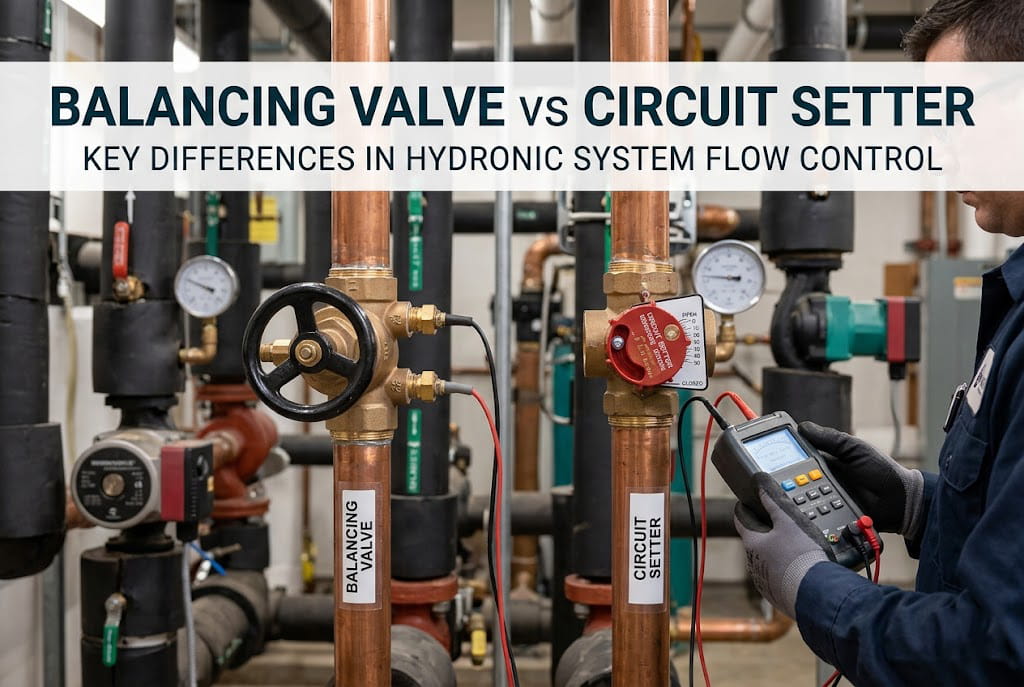
Valve d'équilibrage et régleur de circuit : Principales différences
Permettez-moi de vous expliquer ce qui affecte réellement vos résultats :
Installation et configuration
Vannes d'équilibrage manuelles :
- Nécessite des compteurs de débit séparés pour un équilibrage précis
- Un processus d'installation qui prend du temps
- Coût initial moins élevé
- Nécessité de faire appel à des techniciens expérimentés pour un bon équilibrage
Les régleurs de circuits :
- Préréglable à l'aide des courbes du fabricant
- Une mise en service plus rapide
- Coût initial plus élevé
- Moins de risques d'erreur lors de la mise en place
Précision et mesure
Voici ce qu'il en est :
Les régleurs de circuit offrent généralement une précision de 5% avec une répétabilité élevée. Vannes manuelles ? Vous devez vous contenter de la précision offerte par votre débitmètre (si vous en avez un).
Performance à long terme
C'est là que les choses deviennent intéressantes.
Les soupapes manuelles sont essentiellement à l'épreuve des balles. Il suffit de les régler une fois pour qu'elles fonctionnent pendant des décennies. Il n'y a pas de pièces mobiles susceptibles de tomber en panne, ni de cartouches à remplacer.
Mais les régleurs de circuit ? Bien qu'ils soient plus complexes, ils vous permettent de vérifier les débits des années plus tard. C'est un atout majeur pour maintenir l'efficacité du système.
Quand utiliser chaque type
Permettez-moi de vous épargner quelques maux de tête grâce à ces lignes directrices :
Choisissez les vannes d'équilibrage manuelles quand :
- Travailler sur des systèmes simples à débit constant
- Le budget est serré
- Le système présente des fluctuations de pression minimales
- Un équilibrage approximatif est suffisant
Par exemple, je les utiliserais pour un petit immeuble d'habitation avec une pompe à vitesse constante et quelques zones.
Choisir les régleurs de circuits Quand :
- La précision est essentielle
- Travailler sur des systèmes CVC commerciaux
- Nécessité de mesurer le débit lors de la mise en service
- L'efficacité énergétique est une priorité
- La documentation des débits est requise
Pensez aux hôpitaux, aux centres de données ou à tout autre bâtiment où des problèmes de confort pourraient vous coûter cher.
Choisissez les vannes d'équilibrage automatiques quand :
- Traitement des systèmes à débit variable
- La vitesse des pompes change fréquemment
- La pression du système fluctue de manière significative
- Vous souhaitez un fonctionnement “prêt à l'emploi” ?
Conseil de pro : les vannes de régulation indépendantes de la pression (PICV) combinent l'équilibrage, le contrôle et la régulation de la pression différentielle en un seul dispositif. Elles sont coûteuses mais peuvent valoir la peine pour les systèmes complexes.
Considérations sur les coûts dans le monde réel
Voici ce que personne ne vous dit sur la différence de coût :
Bien sûr, les régleurs de circuit coûtent plus cher au départ. Il s'agit de 2 à 3 fois le prix d'une vanne manuelle de base.
Mais considérez ceci :
- Temps de mise en service avec des régleurs de circuit : 50-70% moins
- Rappels dus à un mauvais équilibrage : Réduction significative
- Économies d'énergie grâce à un bon équilibrage : 10-15% typique
J'ai vu des projets où les économies de main-d'œuvre justifiaient à elles seules le coût supplémentaire de l'équipement.
Les erreurs courantes à éviter
Après avoir vu des centaines d'installations, voici les erreurs qui me font frémir :
1. Sous-dimensionnement pour économiser de l'argent
Cela détruit votre capacité à vous équilibrer correctement. Ne le faites pas.
2. Installation sans tuyaux rectilignes
La plupart des vannes ont besoin de 3 à 5 diamètres de tuyau en amont. Ignorer cette règle est à vos risques et périls.
3. Utilisation de disjoncteurs sur les petits systèmes résidentiels
Totalement exagéré. Économisez l'argent de vos clients.
4. Types de vannes de mélange au hasard
Choisissez une stratégie et tenez-vous-y. La cohérence facilite grandement l'entretien futur.
Le facteur de maintenance
Il s'agit d'un élément essentiel, souvent négligé.
Vannes d'équilibrage manuelles ? Pratiquement aucune maintenance. Il suffit de vérifier la position tous les deux ou trois ans.
Des circuits ? Ils nécessitent peu d'entretien, mais vous voudrez les utiliser :
- Vérifier occasionnellement l'étalonnage
- Vérifier que les orifices de pression ne sont pas obstrués
- S'assurer que les dispositifs d'arrêt de la mémoire fonctionnent toujours
Des vannes automatiques ? C'est là que les choses deviennent intéressantes. Ces cartouches à ressort ne durent pas éternellement. Prévoyez de les remplacer tous les 5 à 10 ans.
Faire le bon choix pour votre système
Voici mon processus de recommandation :
Étape 1 : Déterminer le type de débit
- Débit constant ? Des vannes manuelles pourraient fonctionner
- Débit variable ? Vous avez besoin d'un système automatique ou d'un système PICV
Étape 2 : Tenez compte de vos besoins en matière de précision
- ±20% suffisant ? Vannes manuelles
- Besoin de ±5% ? Régleurs de circuits minimum
Étape 3 : Tenir compte des coûts du cycle de vie
- Ne vous contentez pas de regarder le coût de l'équipement
- Inclure l'installation, la mise en service et l'énergie
Étape 4 : Pensez à l'avenir
- Le système sera-t-il modifié ?
- Qui l'entretiendra ?
- La documentation est-elle essentielle ?
Résultat final
Le choix entre les vannes d'équilibrage et les régleurs de circuit n'est pas vraiment une question de “mieux”. Il s'agit d'adapter le bon outil à votre situation spécifique.
Pour les systèmes commerciaux complexes où la précision est importante, les régleurs de circuit gagnent leur place grâce à un contrôle précis du débit et à une mise en service plus facile.
Pour les systèmes plus simples où le budget est roi, les vannes d'équilibrage manuelles permettent de faire le travail sans se ruiner.
Et pour les systèmes à débit variable ? Les vannes automatiques ou PICV sont pratiquement obligatoires en 2026.
N'oubliez pas qu'un bon équilibrage peut réduire la consommation d'énergie de 10-15% tout en éliminant les plaintes liées au chaud et au froid. Quel que soit le type de vanne que vous choisissez, assurez-vous qu'elle est correctement dimensionnée et installée.
Parce qu'en fin de compte, même le plus beau des circuits ne peut pas réparer un système mal conçu.
La véritable clé est de comprendre les besoins de votre système et de choisir la solution de contrôle de débit qui offre le meilleur équilibre entre performance, coût et fiabilité pour votre application spécifique.