Résumé rapide
Les clapets de non-retour à battant se ferment par gravité et fonctionnent mieux dans les conduites horizontales à débit régulier, offrant une faible perte de charge pour un coût inférieur. Les clapets anti-retour à ressort se ferment rapidement grâce à un mécanisme à ressort, empêchent les coups de bélier et fonctionnent dans toutes les orientations, y compris les conduites verticales.
Choisissez des vannes à battant pour les grands systèmes municipaux et le drainage ; choisissez des vannes à ressort pour les lignes de refoulement des pompes, les systèmes à haute pression et les environnements sensibles au bruit. Un mauvais choix de vannes peut entraîner des dommages aux équipements, des tuyaux bruyants et des réparations coûteuses.
Vous êtes-vous déjà trouvé devant un mur de vannes dans une quincaillerie en vous demandant si vous aviez besoin d'un clapet anti-retour à battant ou d'un clapet anti-retour à ressort ?
Vous n'êtes pas seul.
En tant que professionnel fabricant de clapet anti-retour, Après avoir installé des centaines de ces vannes (et réparé de nombreuses erreurs), je peux vous dire qu'un mauvais choix peut entraîner des tuyaux bruyants, des dommages aux équipements et des réparations coûteuses.
La principale différence ? Les clapets anti-retour à battant et les clapets à ressort se distinguent par leur mode de fermeture. Les clapets de non-retour à battant utilisent la gravité et un disque articulé, tandis que les clapets de non-retour à ressort utilisent - vous l'avez deviné - un mécanisme à ressort. Mais ce n'est pas tout.
Je vais vous expliquer exactement quand utiliser chaque type de produit, afin que vous puissiez faire le bon choix du premier coup.
Qu'est-ce qu'un clapet anti-retour à battant ?
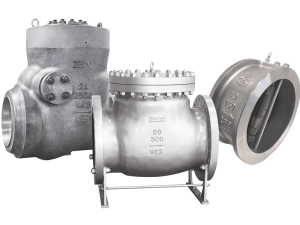
A clapet anti-retour à battant est en fait une porte à sens unique pour vos tuyaux.
Voici comment cela fonctionne :
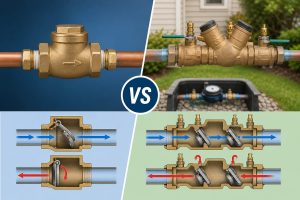
Un disque (ou “clapet”) est suspendu à une charnière à l'intérieur du robinet. Lorsque l'eau s'écoule vers l'avant, elle pousse le disque à s'ouvrir. Lorsque le débit s'arrête ou s'inverse, la gravité fait basculer le disque vers la fermeture.
C'est simple, non ?
C'est un peu comme une porte pour animaux de compagnie qui ne pivote que dans un sens. Les fluides peuvent être poussés dans la bonne direction, mais ils ne peuvent pas revenir.
Les éléments clés sont les suivants :
- Corps (le logement principal)
- Disque (la porte battante)
- Charnière (ce sur quoi le disque pivote)
- Siège (où le disque est scellé lorsqu'il est fermé)
J'ai trouvé qu'ils fonctionnaient très bien dans :
- Systèmes municipaux de distribution d'eau
- Canalisations d'égouts
- Grands pipelines industriels
- Systèmes de drainage
Mais voilà : ils ne sont pas parfaits pour toutes les situations.
Qu'est-ce qu'un clapet anti-retour à ressort ?
Parlons maintenant des clapets anti-retour à ressort (également appelés clapets anti-retour à ressort).
Ces derniers utilisent une approche totalement différente :
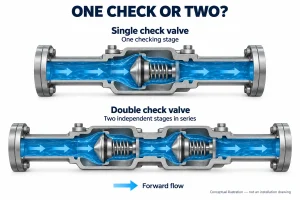
Au lieu de la gravité, ils utilisent un ressort pour maintenir un disque, une bille ou un clapet contre le siège de la vanne. Lorsque la pression en amont est suffisamment élevée, elle surmonte la force du ressort et pousse la soupape à s'ouvrir.
Au moment où la pression chute ? SNAP-le ressort le ferme.
Les principaux éléments sont les suivants :
- Corps (similaires aux vannes à battant)
- Printemps (la star du spectacle)
- Disque/Boule/Poppet (l'élément de scellement)
- Siège (surface d'étanchéité)
Je les recommande pour :
- Lignes de refoulement des pompes
- Systèmes CVC
- Tuyauterie verticale
- Applications à haute pression
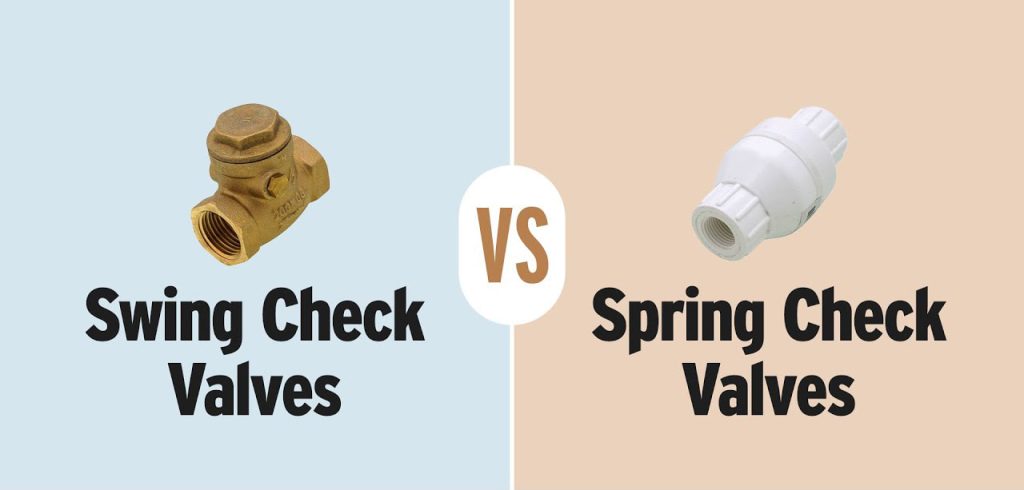
Clapet anti-retour à battant et ressort : Principales différences
Permettez-moi de vous épargner quelques maux de tête avec cette comparaison :
Orientation de l'installation
Clapets anti-retour à battant: Principalement limité aux tuyaux horizontaux. Ils PEUVENT fonctionner à la verticale, mais uniquement si le flux est ascendant. La gravité ne les fermera pas correctement en cas de flux descendant.
Clapets anti-retour à ressort: Fonctionne dans N'IMPORTE QUELLE orientation. Horizontal, vertical vers le haut, vertical vers le bas, peu importe. C'est le ressort qui fait le travail, pas la gravité.
Chute de pression
C'est très important pour l'efficacité du système :
Clapets anti-retour à battant: Perte de charge très faible. Le disque bascule presque complètement hors de la trajectoire du flux.
Clapets anti-retour à ressort: Perte de charge plus importante. Le flux lutte constamment contre la tension du ressort.
Dans un système industriel sur lequel j'ai travaillé, le passage des vannes à ressort aux vannes à battant a permis de réduire la perte de charge de 40%. Il s'agit là d'une véritable économie d'énergie.
Vitesse de fermeture et coup de bélier
Vous avez déjà entendu des bruits de tuyaux lorsque vous fermez un robinet ? C'est un coup de bélier.
Clapets anti-retour à battant: Fermeture lente. Cela peut amplifier les coups de bélier car le disque se referme lorsque le débit s'inverse.
Clapets anti-retour à ressort: Se ferment RAPIDEMENT. Souvent appelées “silencieuses” ou “sans claquement” car le ressort les ferme avant que le débit ne s'inverse.
Considérations sur les coûts
Parlons argent :
Clapets anti-retour à battant: Généralement 30-50% moins cher à l'avance.
Clapets anti-retour à ressort: Coût initial plus élevé, mais possibilité d'économiser de l'argent à long terme en évitant les dégâts causés par les coups de bélier.
Quand choisir un clapet anti-retour à battant
Les clapets de non-retour à battant brillent dans des situations spécifiques :
1. Tuyaux de grand diamètre
Pour les tuyaux de plus de 4 pouces, il est souvent plus judicieux d'utiliser des contrôles de balancement. Plus le tuyau est grand, plus la perte de charge est importante.
2. Systèmes à basse pression
Les conduites d'eau municipales, les systèmes alimentés par gravité et les applications de drainage conviennent parfaitement aux vannes à battant.
3. Applications en régime permanent
Si votre débit ne varie pas beaucoup, les vannes à battant conviennent parfaitement. Pensez aux systèmes d'irrigation ou aux flux de processus continus.
4. Projets soucieux du budget
Lorsque le coût initial est critique et que les coups de bélier ne sont pas un problème, les vannes à battant sont gagnantes.
Conseil de pro: Les clapets de non-retour à battant doivent toujours être installés avec l'axe d'articulation à l'horizontale. J'en ai vu trop installés latéralement qui ne fermaient pas correctement.
Quand choisir un clapet anti-retour à ressort
Les clapets anti-retour à ressort sont la solution idéale :
1. Lignes de refoulement de la pompe
Les pompes créent des flux pulsés et des arrêts soudains. Les vannes à ressort répondent parfaitement à ces besoins.
2. Installations verticales
Besoin d'empêcher le retour d'eau dans une conduite verticale ? Une soupape à ressort, sans aucun doute.
3. Systèmes à haute pression
Le ressort assure une fermeture positive, même à des pressions élevées où les vannes à battant pourraient flotter.
4. Environnements sensibles au bruit
Hôpitaux, appartements, bureaux - partout où des tuyaux qui claquent posent problème.
5. Conditions d'écoulement variables
Les systèmes avec des démarrages/arrêts fréquents ou des inversions de débit nécessitent la réponse rapide des vannes à ressort.
Exemples d'application dans le monde réel
Permettez-moi de vous faire part de quelques scénarios spécifiques que j'ai rencontrés :
Conduite d'eau municipale : Swing Check Won
Le service des eaux d'une ville m'a demandé des clapets anti-retour pour sa conduite principale de 12 pouces. Avec un débit régulier et un budget serré, les clapets à battant étaient parfaits. Trois ans plus tard ? Ils fonctionnent toujours aussi silencieusement.
Système de pompage en hauteur : La vérification de printemps a sauvé la mise
Un immeuble de 40 étages a connu de terribles coup de bélier avec des clapets de retenue. Nous avons opté pour des soupapes à ressort. Le bruit a disparu du jour au lendemain.
Tour de refroidissement industrielle : Approche mixte
C'est ici que les choses deviennent intéressantes. Nous avons utilisé des clapets de retenue sur les gros collecteurs d'alimentation (faible perte de charge), mais des clapets à ressort sur les conduites de refoulement de la pompe (pour éviter les coups de bélier).
Les erreurs courantes à éviter
J'ai vu ces erreurs coûter des milliers d'euros :
1. Mauvaise orientation
Installation d'un clapet anti-retour à la verticale pour un écoulement vers le bas. Il restera ouvert en permanence.
2. Ignorer la pression de fissuration
Les soupapes à ressort ont besoin d'une pression minimale pour s'ouvrir. Un ressort trop puissant = pas de débit.
3. Surdimensionnement
Le plus gros n'est pas toujours le meilleur. Les soupapes surdimensionnées peuvent flotter et s'user rapidement.
4. Flèche d'écoulement manquante
Chaque clapet anti-retour est muni d'une flèche indiquant le sens d'écoulement. Vous l'installez à l'envers ? Débit nul.
Considérations matérielles
Les deux types de vannes sont disponibles dans différents matériaux :
- Laiton: Excellent pour l'eau, coût raisonnable
- Acier inoxydable: Résistant à la corrosion, supporte les températures élevées
- PVC: Bon marché, bon pour les produits chimiques
- Fonte: Durable, parfait pour les gros tuyaux
Adaptez le matériau à votre fluide et à vos conditions. Eau chaude + PVC = désastre.
Entretien et durée de vie
Voici ce à quoi il faut s'attendre :
Clapets anti-retour à battant:
- Inspection annuelle
- Vérifier l'usure des charnières
- Remplacer le siège en cas de fuite
- Durée de vie typique : 10-20 ans
Clapets anti-retour à ressort:
- Vérifier la tension du ressort chaque année
- Recherche de fatigue ou de corrosion
- Le remplacement des ressorts peut s'avérer nécessaire après 5 à 10 ans
- Durée de vie typique : 8-15 ans
Prendre la décision finale
Le résultat ?
Choisir clapets anti-retour à battant lorsque vous l'avez fait :
- Tuyaux horizontaux
- Flux régulier
- Grands diamètres
- Des budgets serrés
- Systèmes à basse pression
Choisir clapets anti-retour à ressort quand vous en avez besoin :
- Flexibilité de l'orientation
- Fonctionnement silencieux
- Fermeture rapide
- Manipulation sous haute pression
- Protection de la pompe
Vous n'êtes toujours pas sûr ? Voici ma règle de base :
En cas de doute, optez pour les contrôles à ressort pour les bâtiments résidentiels et commerciaux. Utilisez les clapets à battant pour les applications municipales et industrielles avec des tuyaux de grande taille.
Considérations futures pour 2026
À l'horizon 2026, je constate une tendance à la hausse :
- Vannes intelligentes avec capteurs de position
- Des matériaux de ressort améliorés qui durent plus longtemps
- Conceptions hybrides combinant les deux technologies
Mais les principes fondamentaux restent les mêmes. Comprendre quand utiliser un clapet anti-retour à battant plutôt qu'un clapet à ressort vous fera gagner du temps, de l'argent et des maux de tête.
Rappelez-vous : Le bon robinet au bon endroit fait toute la différence. Prenez le temps d'analyser vos besoins spécifiques avant d'acheter.
Vous êtes confronté à une situation délicate en matière de vannes ? Les principes énoncés dans ce guide vous orienteront dans la bonne direction. Il vous suffit de faire correspondre les exigences de votre application aux points forts de chaque vanne, et vous ferez le bon choix à chaque fois.