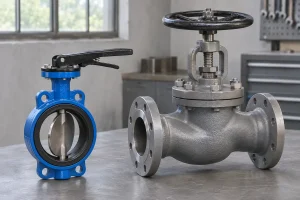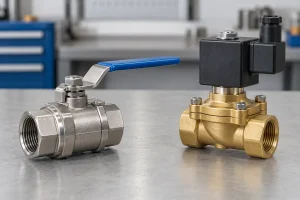
The choice between butterfly valve and globe valve usually comes down to the job: butterfly valves offer a compact body and lower fully open pressure loss, while globe control valves suit precise throttling. Choose a butterfly valve for suitable large-flow isolation duties, and start with a globe control valve when you need stable regulation.
| Selection factor | Butterfly valve | Globe valve |
|---|---|---|
| Operating movement | Rotating disc; typically 90° from closed to fully open | Linear plug or disc movement; manual versions usually use a multi-turn handwheel |
| Flow path | Relatively direct, with the disc remaining in the flow | Flow passes through a seat opening; body pattern affects resistance |
| Flow regulation | Suitable designs handle modulation; check the usable control range | Control designs offer trim options for precise regulation |
| Fully open pressure loss | Usually lower for comparable nominal sizes and flow | Usually higher; verify the exact flow coefficient |
| Space and weight | Often shorter and lighter, especially in wafer or lug designs | Often longer and heavier, with bonnet and actuator clearance needed |
| Purchase cost | Often economical at larger diameters | Often higher at larger diameters; trim and actuation affect price |
| Shutoff performance | Depends on seat design, rating, direction, and test conditions | Depends on seat design, rating, direction, and test conditions |
| Typical starting applications | Water mains, cooling-water isolation, and suitable HVAC control | Steam regulation, process flow control, and pressure reduction |
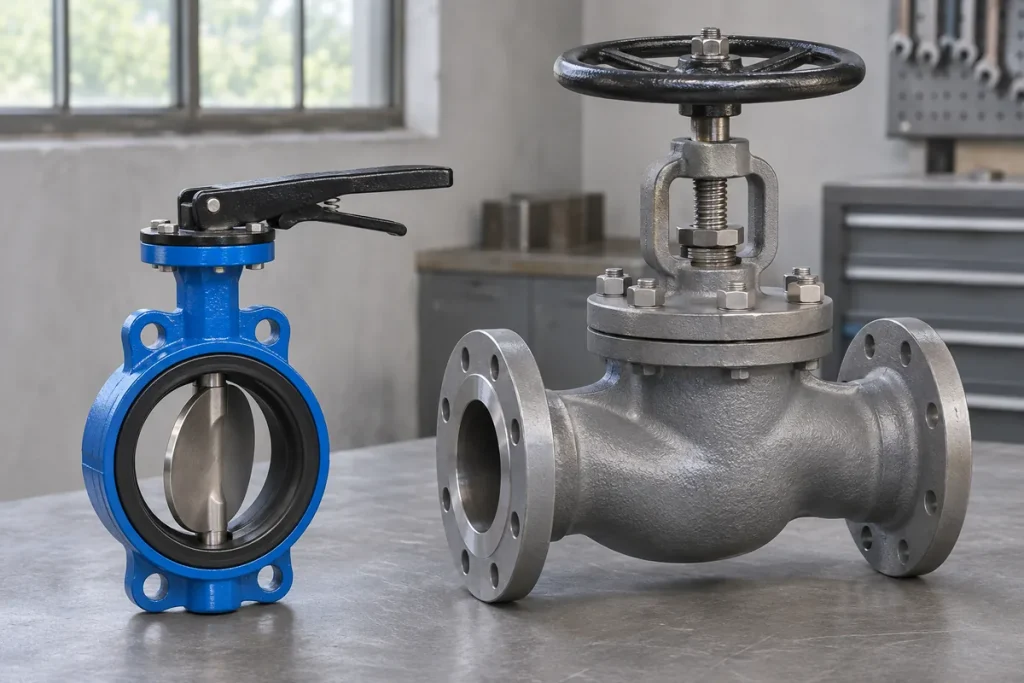
The globe valves suit throttling and butterfly valves offer low resistance when open, and butterfly designs can handle control duties.
Butterfly Valve vs Globe Valve Comparison
How Butterfly and Globe Valves Work
A butterfly valve controls flow by rotating a disc. A globe valve moves a plug or disc toward a seat to change the opening. Those movements affect both how the valve controls flow and how much room it needs.
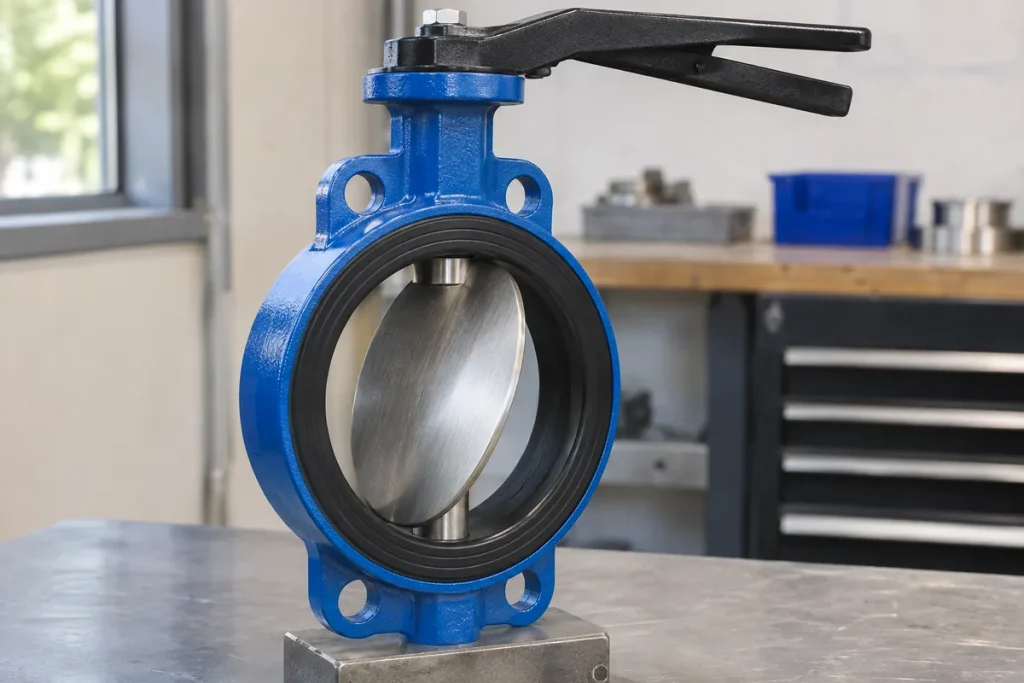
Butterfly valves rotate a disc across the pipe
A butterfly valve opens as its disc rotates toward alignment with the flow. Turn it toward the closed position, and the disc blocks the passage and engages the seat.
The disc stays inside the bore even when fully open. It still obstructs some flow, so even a fully open butterfly valve has a pressure loss.
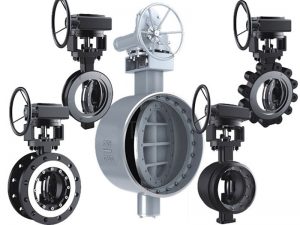
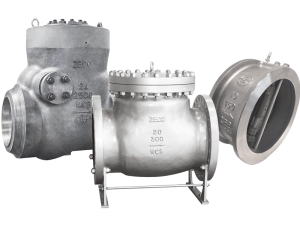
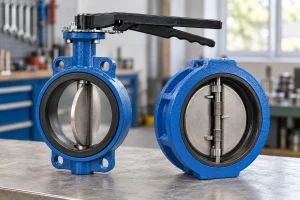
You’ll encounter concentric, double-offset, and triple-offset designs. ZECO’s butterfly valve range includes offset and metal-seated options. Check the geometry and seal arrangement for your service: a resilient-seated water valve and a metal-seated process valve have different limits.
Globe valves adjust a seat opening
A conventional globe valve moves its plug toward or away from a seat to change the available flow area. Manual versions generally use a handwheel; automated versions use an actuator to position the stem.
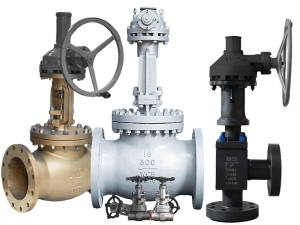
A straight-pattern globe body redirects flow around the seat. Y-pattern and angle bodies change that path to suit different pressure-loss or service requirements. ZECO’s globe valve guide and product range explains these body patterns and lists available configurations.
Linear stem movement doesn’t necessarily produce linear flow. The plug profile and other internal parts, collectively called the trim, determine the valve’s inherent flow characteristic.
Which Valve Gives You Better Flow Control?
A correctly sized globe control valve is usually the first option to assess for precise, continuous throttling. A butterfly control valve can also work well, particularly at high flow rates, if its disc, actuator, and operating range suit the duty.
Take a heat exchanger that needs to hold its outlet temperature as demand changes. Its valve has to make useful adjustments at low load as well as near full production. A valve that handles the peak flow can still struggle at minimum demand.
For either valve, ask for:
- The flow coefficient at different travel positions.
- The manufacturer’s recommended control range.
- Predicted operation at minimum, normal, and maximum flow.
- Actuator and positioner performance under the expected load.
- Limits for noise, vibration, and differential pressure.
A positioner helps the actuator reach the commanded position, but an oversized valve or unsuitable trim will still cause problems.
The applications needing large capacity and a small installed footprint. It also cautions that sizing and changing process loads matter, while characterized disc designs can expand the control range.
I’d check the documented control range before spending more on the actuator. For a closer look at disc position and sizing, see ZECO’s guide to using butterfly valves for flow control.
Pressure Drop: Compare the Same Operating Conditions
At the same flow and comparable nominal size, a fully open butterfly valve usually loses less pressure than a conventional globe valve. For throttling, compare the actual opening and flow coefficient of each candidate.
An isolation valve may spend most of its life fully open, so its resistance adds to the pumping head whenever the system runs. The U.S. Department of Energy’s Energy Savings Opportunities in Control Valves explains that the power needed to overcome a pressure drop rises with both the flow rate and the size of that drop.
A control valve deliberately creates a changing restriction to regulate flow. Reducing its design pressure drop too far can weaken its ability to control the system.
There has a tradeoff: an oversized control valve may reduce fully open resistance while producing large flow changes over a small part of its travel.
Compare both candidates at the same flow, fluid condition, and required duty. A fully open butterfly valve and a partly closed globe valve are doing different jobs.
Cavitation and flashing need a separate check
Both valve types need a cavitation and flashing check where the liquid conditions create a risk. Look at the liquid’s temperature and its pressure through the restriction and downstream.
Cavitation starts when local pressure falls below the liquid’s vapor pressure and bubbles form. As pressure recovers, the bubbles collapse and can damage nearby surfaces.
Flashing occurs when downstream pressure stays below vapor pressure. Vapor persists, and the liquid-vapor mixture can erode the valve and downstream piping.
Suitable globe-valve trim can help manage cavitation; the body type alone doesn’t provide that protection. The valve selection cannot prevent flashing imposed by the process conditions; geometry and materials help limit damage.
Butterfly Valve vs Globe Valve Cost: Compare the Whole Installation
Butterfly valves often cost less to buy in larger sizes. To compare the full cost, include installation and operation as well as the valve price. Materials, pressure rating, seat construction, control requirements, and actuation can all change which option costs less.
Make sure the quotations cover the same requirements. A manual resilient-seated butterfly valve and an automated globe control valve include different equipment. Price each complete package:
- The valve body, seat, trim, and required testing.
- The actuator, positioner, switches, and accessories.
- Pipe modifications, supports, lifting, and installation access.
- Pumping energy, maintenance, spares, and downtime.
A fixed percentage saving would be misleading. A metal-seated butterfly valve built for demanding service may cost more than a simple globe valve with a different specification.
A worked example shows why energy matters
Extra pressure loss costs money when the pump has to supply the additional head. Here’s a calculation using hypothetical inputs; it doesn’t represent measured savings from particular valves.
Assume a water system has:
- Flow of 0.02 m³/s, equivalent to 72 m³/h.
- An avoidable additional pressure drop of 50 kPa.
- Combined pump and motor efficiency of 70%.
- Operation for 6,000 hours per year.
- Electricity priced at $0.12 per kWh.
The extra electrical input is approximately:
Power = flow × pressure drop ÷ efficiency
Using consistent units: 0.02 × 50,000 ÷ 0.70 = 1,429 watts, or about 1.43 kW.
That is roughly 8,570 kWh and $1,030 per year under these assumptions.
Actual savings depend on the pump curve and controls. Removing resistance from a fixed-speed system may increase flow instead of cutting power by that amount. The pump and system curves establish the operating point. Check that point before treating the calculation as an energy-saving estimate.
Butterfly Valve vs Globe Valve Size: Pipe Diameter Is Only the Start
Butterfly valves often save space and weight as pipe diameter increases. Globe control valves need to be sized for the required flow and pressure drop, so pipe diameter alone can’t decide between them.
For example, Bray lists its Series 30/31 butterfly-valve range at NPS 2–20, or DN 50–500. Butterfly valves clearly aren’t limited to pipes 8 inches and larger.
For installation, compare more than the nominal diameter:
- Face-to-face length between the pipe connections.
- Total height and actuator clearance.
- Assembly weight and support requirements.
- Space to remove the actuator, bonnet, or internal parts.
- Butterfly-disc clearance inside adjacent pipework and fittings.
Check the flow capacity even when the flange size matches. An automatic control valve may need a smaller body than the connecting pipe.
Use flow capacity to check the size
The flow coefficient, Cv, relates liquid flow to pressure drop and helps you compare actual valve capacity. For turbulent, non-choked liquid flow, a simplified relationship using US customary units is:
Cv = Q × √(SG ÷ ΔP)
Here, Q is flow in US gallons per minute, SG is liquid specific gravity relative to water, and ΔP is valve pressure drop in psi.
For a hypothetical water duty of 100 US gpm at 10 psi differential pressure, SG is approximately 1. The required Cv is therefore 100 × √(1 ÷ 10), or about 31.6.
For control service, find Cv 31.6 on each candidate’s travel curve. Then repeat the calculation at minimum and maximum demand to check whether the valve can control the whole range.
The simplified equation does not cover every condition. Viscosity, reducers, cavitation, and choked flow can require corrections; steam and gases need compressible-flow sizing methods.
Pressure, Temperature, and Shutoff Can Change the Choice
Check the exact valve’s pressure-temperature rating, materials, and leakage specification against your service. Those limits vary within each valve family.
A resilient seat that works in chilled water may be unsuitable for steam or a particular chemical. Metal seats can extend the application range, but their leakage performance still needs verification.
Check the body, seat, disc or trim, stem packing, and actuator. Every part of the assembly has to suit the service.
Both types can provide tight shutoff
Both types can meet demanding shutoff requirements when specified for the duty. Compare the seat construction, differential pressure, actuator output, flow direction, and test conditions before deciding which seals better.
For example, Bray describes the Series 30/31 as providing bidirectional bubble-tight shutoff within its stated ratings. That rating applies to the stated product family and conditions.
Ask the supplier to state the test standard, test medium, pressure, permitted leakage, and applicable direction. Treat an unsupported promise of “zero leakage” as an incomplete specification.
Seat leakage passes through a closed valve. External leakage escapes through packing, joints, or the pressure boundary. Specify both requirements where they matter.
Maintenance access belongs in the specification
The easier valve to maintain is the one whose design and installation let you reach and replace the worn parts. Compare access, tools, spare parts, and downtime for the repairs you expect.
Some globe designs allow trim access through the bonnet while the body stays in the pipeline. Some butterfly-valve seat replacements require removing the valve from between the flanges.
Confirm the procedure in the maintenance manual. If there isn’t room to remove a worn part, the compact installation may cost more to repair.
Which Valve Fits Your Application?
For isolation, low fully open resistance may carry the most weight. For modulation, the valve has to control the required flow range. Consider these hypothetical duties when drawing up your shortlist.
Large cooling-water isolation line
A butterfly valve is usually a sensible choice to assess for a large cooling-water isolation line. It combines low fully open resistance with a compact body. ZECO’s guide to flanged butterfly valve applications covers cooling-water and other large-diameter services.
Confirm water chemistry, solids content, seat compatibility, and the maximum shutoff differential pressure. Set a closing speed that stays within the system’s transient-pressure limits, even though the disc only needs a quarter turn.
Steam supply to a heat exchanger
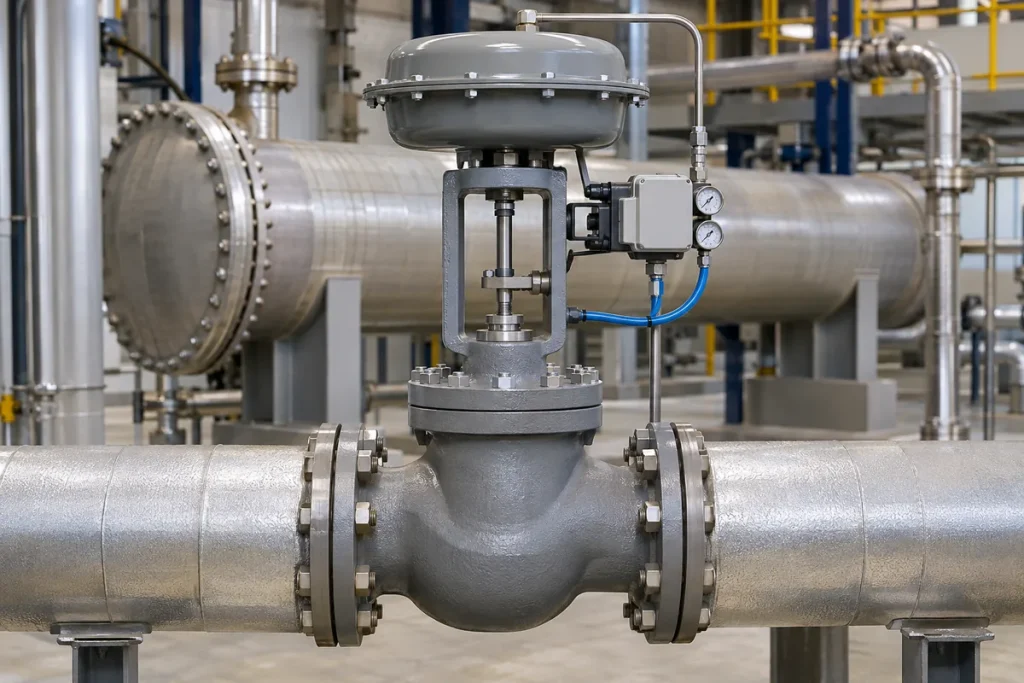
A globe control valve usually suits a steam supply that must respond to changing heat demand. Select the trim and actuator to regulate flow across the required operating range.
Check minimum load as carefully as peak load. Steam conditions, pressure ratio, noise, and required shutoff all affect the final selection.
Variable-flow water circuit
Either valve type may work in a modulating water circuit, depending on the flow range and control requirements. A control-grade butterfly valve can offer useful capacity and space savings, while a globe valve may better suit fine regulation at lower flows.
Compare the calculated operating positions and control performance. With an oversized Cv, much of the valve’s travel may have little useful effect on flow.
How to Choose in Five Steps
Give the supplier enough operating data to calculate the size and check the assembly. Work through these five steps before accepting a selection:
- Define the duty. State whether the valve isolates, throttles occasionally, or modulates continuously. Include operating frequency and the required response if power or instrument air fails.
- Record the process conditions. Supply fluid composition, temperature, minimum and maximum pressures, and minimum, normal, and maximum flow. Include solids, viscosity, or corrosion concerns.
- Size both candidates. Request the required Cv or Kv, predicted travel positions, pressure-drop calculations, and checks for cavitation, flashing, or noise where relevant.
- Verify the installation and shutoff. Confirm connections, pressure-temperature ratings, leakage criteria, actuator force or torque, clearance, and maintenance access.
- Compare complete quotations. Review purchase price alongside installation work, energy implications, spare parts, and expected service demands.
I’d ask for the selection calculation with the quotation. If you’re requesting a valve quotation from ZECO, include the operating data above so the size, materials, and actuation can be assessed together.
Make the Choice Around the Required Duty
Choose a butterfly valve when it meets the duty and its compact size, capacity, or lower fully open resistance benefit the installation. Choose a globe control valve when precise regulation and suitable trim justify the added space, weight, and pressure loss.
Before ordering, confirm the calculations and exact product specification with the responsible engineer or valve supplier. That gives you the operating data to settle the choice between butterfly valve and globe valve.