Quick Summary
Check valves automatically prevent backflow and protect equipment like pumps from reverse flow damage – they’re your system’s one-way street. Ball valves provide manual on/off control with a quarter-turn handle for shutoff and isolation.
The fundamental difference: check valves work automatically based on flow conditions, while ball valves require manual or automated operation. Using the wrong type can cause equipment damage, with incorrect valve selection being one of the top 3 reasons for premature pump failure.
You’re spec’ing out a new pump system. The supplier asks: “Do you need check valves or ball valves for this application?”
And you freeze.
Because even though both control flow, mixing them up can lead to equipment damage, system failure, and costly callbacks.
In fact, using the wrong valve type is one of the top 3 reasons for premature pump failure (according to a recent industry study).
The good news? Understanding check valve vs ball valve differences is actually pretty straightforward once you know what to look for.
In this guide, as a professional check valve manufacturer and ball valve manufacturer, I’ll break down exactly when to use each type, their key differences, and real-world examples from the field.
Let’s dive in.
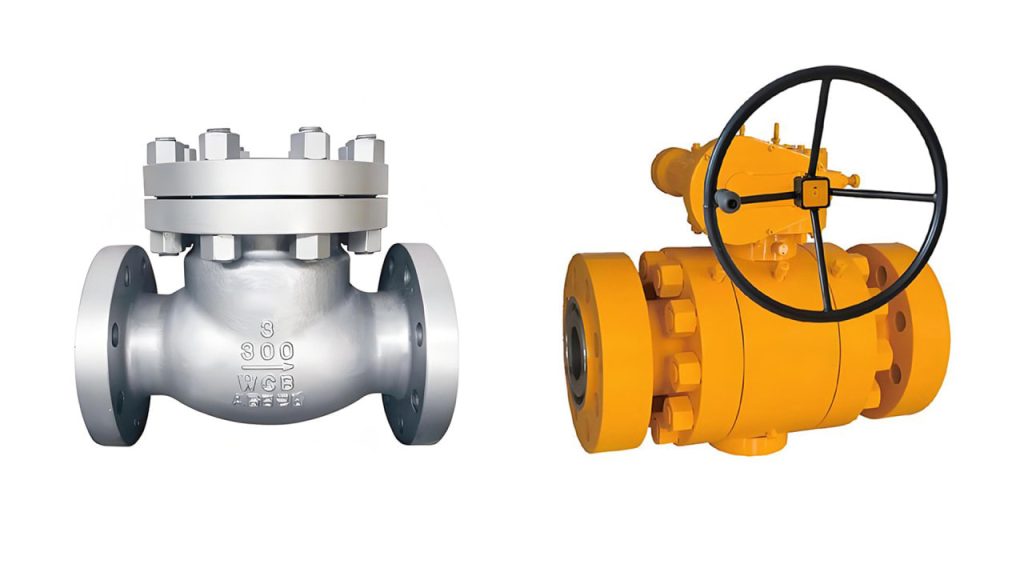
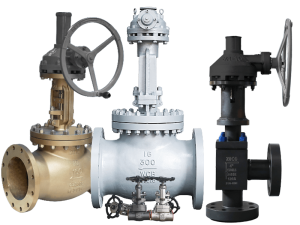
What Is a Check Valve?
A check valve is like a one-way street for fluids.
It automatically allows flow in one direction and blocks it in the reverse direction. No manual operation required.
Think of it as your system’s bodyguard against backflow.
How Check Valves Work
Here’s the simple version:
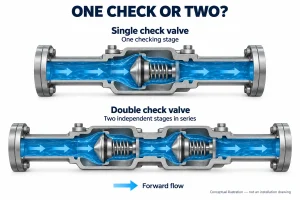
When fluid flows forward, it pushes the valve’s internal mechanism open. When flow stops or reverses, the valve automatically slams shut.
This happens through:
- Spring force
- Gravity
- Back pressure
- Or a combination of these
The beauty? It’s completely automatic. No electricity, no manual operation, no maintenance crew needed.
Common Types of Check Valves
Swing Check Valves
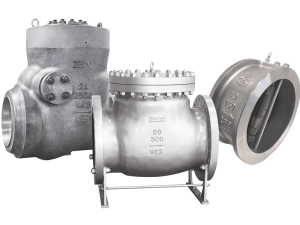
The most common type. A hinged disc swings open with forward flow and swings closed when flow reverses.
Best for: Large pipe diameters and low-pressure drop applications.
Ball Check Valves
Uses a ball that moves up and down in the valve body. Forward flow lifts the ball off its seat. Reverse flow (or gravity) pushes it back down.
Best for: Viscous fluids and vertical pipe runs.
Spring Check Valves
Features a spring-loaded disc. The spring provides positive closing action even in low-pressure situations.
Best for: Any orientation installation and fast-closing requirements.
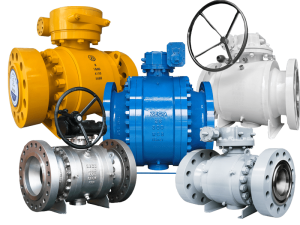
What Is a Ball Valve?
A ball valve is your system’s on/off switch.
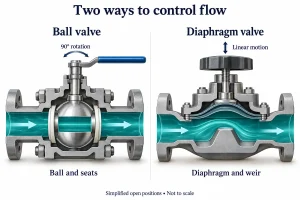
It uses a rotating ball with a hole through it to control flow. Quarter turn of the handle, and you go from full flow to complete shutoff.
How Ball Valves Work
Picture a ball with a tunnel drilled through it.
When the tunnel lines up with the pipe, fluid flows. Turn the handle 90 degrees, and the solid part of the ball blocks the flow path.
Simple. Reliable. Effective.
That’s why ball valves are found in everything from your home’s water heater to massive industrial pipelines.
Types of Ball Valves
Full Port Ball Valves
The hole through the ball matches the pipe diameter. Zero restriction when open.
Best for: Applications requiring maximum flow capacity.
Standard Port Ball Valves
The hole is about 80% of the pipe diameter. Slightly restricted flow but more compact.
Best for: Space-limited installations where some pressure drop is acceptable.
3-Way Ball Valves
Can divert flow between different ports. One inlet, two outlets (or vice versa).
Best for: Mixing or diverting applications.
Check Valve vs Ball Valve: Head-to-Head Comparison
Let me break down the key differences:
Primary Function
Check Valve: Automatic backflow prevention
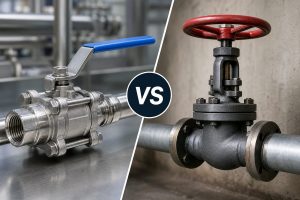
Ball Valve: Manual flow control (on/off)
This is THE fundamental difference. Check valves work automatically. Ball valves need someone (or something) to operate them.
Operation Method
Check Valve: Self-actuating based on flow conditions
Ball Valve: Manual handle or automated actuator
I’ve seen engineers try to use ball valves for backflow prevention. Bad idea. By the time someone notices reverse flow and closes the valve, damage is already done.
Flow Control Capability
Check Valve: No control – either open or closed based on flow
Ball Valve: Full control – can stop, start, or throttle flow
(Though throttling with standard ball valves isn’t recommended – it damages the seats.)
Installation Requirements
Check Valve: Must be installed in correct flow direction
Ball Valve: Can be installed in any orientation
Pro tip: That arrow on the check valve body? It’s not a suggestion. Install it backwards and it won’t work. At all.
Maintenance Needs
Check Valve: Minimal – inspect for wear annually
Ball Valve: Periodic operation required to prevent seizing
In my experience, ball valves in rarely-used lines tend to stick. Exercise them quarterly to keep them operational.
When to Use Each Valve Type
Here’s my simple decision framework:
Use a Check Valve When:
- Protecting pumps from backflow
- Install on pump discharge to prevent reverse spinning
- Prevents water hammer damage
- Preventing contamination
- Keeps dirty water from flowing back into clean systems
- Essential for potable water applications
- Maintaining system pressure
- Holds pressure in accumulator tanks
- Prevents drainage of vertical pipe runs
- Automatic operation is needed
- No power available
- Unmanned locations
Use a Ball Valve When:
- Manual shutoff is required
- Equipment isolation for maintenance
- Emergency shutdown capability
- Frequent operation expected
- Daily on/off cycles
- Process batch operations
- Tight shutoff is critical
- Zero leakage applications
- Hazardous fluid containment
- Quick operation matters
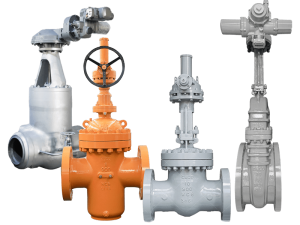
- Quarter-turn vs multi-turn gate valves
- Emergency response situations
Real-World Examples
Let me share some examples from actual installations:
Example 1: Pump Station Design
Situation: New sewage lift station with three pumps
Solution:
- Ball valves on pump suction (for maintenance isolation)
- Check valves on pump discharge (for backflow prevention)
- Ball valves after check valves (for system isolation)
This combination provides both automatic protection and manual control.
Example 2: Compressed Air System
Situation: Air compressor feeding multiple work stations
Solution:
- Check valve at compressor outlet (prevents system air from flowing back)
- Ball valves at each workstation drop (for individual control)
The check valve protects the compressor. The ball valves let workers control their air supply.
Example 3: Chemical Injection System
Situation: Chlorine injection into water main
Solution:
- Check valve at injection point (prevents main pressure from backing up)
- Ball valve before check valve (for maintenance and flow control)
Without the check valve, main pressure would push water back into the chemical tank. Dangerous and expensive.
Common Mistakes to Avoid
I’ve seen these errors countless times:
Mistake #1: Using Ball Valves for Backflow Prevention
Ball valves don’t close automatically. By the time someone notices backflow and closes the valve manually, your pump might already be damaged.
Fix: Always use check valves for automatic backflow prevention.
Mistake #2: Installing Check Valves Backwards
That flow arrow isn’t decorative. Install a check valve backwards and it either won’t open (no flow) or won’t close (no backflow protection).
Fix: Double-check flow direction before installation. Test after installation.
Mistake #3: Throttling with Standard Ball Valves
Using a partially open ball valve for flow control erodes the seats and creates turbulence.
Fix: Use full open/closed positions only. For throttling, use globe valves or specialized control valves.
Mistake #4: Wrong Check Valve Orientation
Many check valves only work in specific orientations. A swing check installed vertically won’t function properly.
Fix: Verify orientation requirements. Spring-loaded checks work in any position.
Installation Best Practices
Here’s how to ensure proper installation:
For Check Valves:
- Verify flow direction – Arrow points downstream
- Check orientation specs – Some types need horizontal installation
- Provide straight pipe runs – 5 pipe diameters upstream, 2 downstream
- Consider access – For future inspection and replacement
For Ball Valves:
- Install with handle clearance – Full 90-degree rotation
- Orient for ergonomics – Easy reach for operators
- Support valve weight – Don’t let pipes carry valve load
- Label clearly – What it controls and normal position
Sizing Considerations
Getting the size right matters for both types:
Check Valve Sizing
Too small = High pressure drop and premature wear
Too large = Valve may not fully open or could chatter
Rule of thumb: Size for normal flow velocity of 6-10 ft/sec
Ball Valve Sizing
Usually matches pipe size for on/off service. But consider:
- Cv (flow coefficient) requirements
- Acceptable pressure drop
- Future flow increases
Cost Comparison
Let’s talk money:
Check Valves: Generally less expensive
- Swing check: $50-500 for common sizes
- Ball check: $75-750
- Spring check: $100-1000
Ball Valves: Moderate pricing
- Bronze threaded: $25-250
- Stainless flanged: $200-2000
- Automated: $500-5000+
But here’s the thing:
The valve cost is tiny compared to the cost of failure. Choose based on function, not just price.
Maintenance Requirements
Both valve types are relatively low-maintenance, but they’re not maintenance-free.
Check Valve Maintenance
Annual inspection:
- Check for leakage
- Listen for chatter or hammering
- Verify proper operation
Every 3-5 years:
- Disassemble and inspect internals
- Replace worn seats or discs
- Clean debris from valve body
Ball Valve Maintenance
Quarterly:
- Cycle valve fully open to closed
- Check for handle resistance
- Inspect stem packing for leaks
Annually:
- Lubricate if applicable
- Tighten packing if needed
- Verify shutoff capability
The Bottom Line
Here’s what it comes down to:
Check valve vs ball valve isn’t about which is better. It’s about which is right for your specific application.
Check valves = Automatic backflow prevention
Ball valves = Manual flow control
Most systems need both. They work together to provide complete flow control and system protection.
The key is understanding their distinct functions and using each where it makes sense.
Remember: A check valve can’t replace a ball valve’s shutoff capability. And a ball valve can’t replace a check valve’s automatic protection.
Choose accordingly, and your systems will thank you with years of reliable service.
Still unsure which valve you need? Start by asking: “Do I need automatic protection or manual control?” The answer will point you in the right direction every time.
That’s the real difference between check valve vs ball valve applications – one protects your system automatically, the other gives you control when you need it.