Quick Summary:
- A standard globe valve has straight-through ports and causes higher pressure drop due to its S‑shaped flow path, but it offers superior throttling control.
- An angle valve (a type of globe valve) has 90° ports, creates less turbulence, saves space, and reduces pressure drop—but only works where a right‑angle turn is needed.
- Your choice depends on layout: use a globe valve for straight‑line precision throttling; use an angle valve when you need a direction change and want to cut leak points and installation complexity.
So you’re standing in front of a piping system, trying to figure out which valve to use.
Angle valve vs globe valve. It’s a debate that comes up more often than you’d think.
Both of these valves are excellent for regulating flow. But they’re designed for different situations. And picking the wrong one? That can cost you time, money, and performance.
In this article, as a professional globe valve manufacturer, let me break this down for you.
Pro Tip: I’ve spent years analyzing fluid control systems. And the one thing I keep coming back to is this: understanding the difference between an angle valve vs globe valve can save you from costly mistakes down the line.
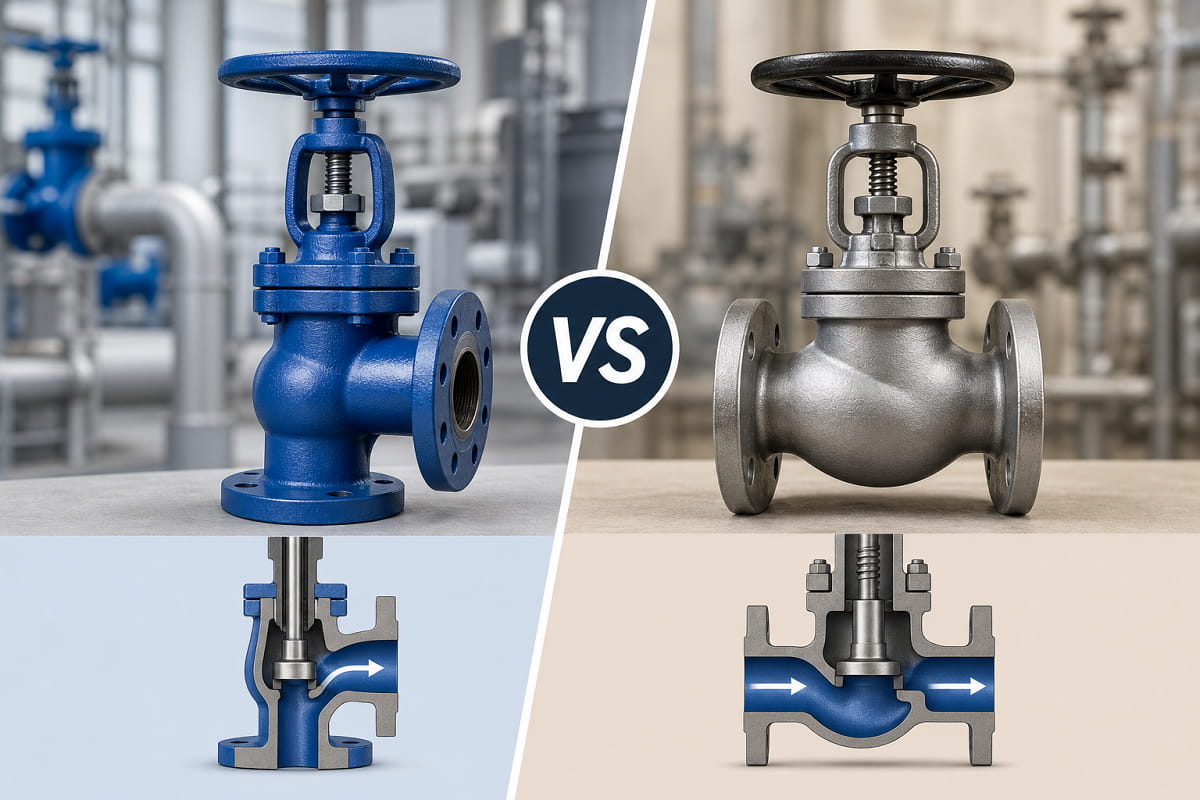
The Simple Truth About Angle Valve vs Globe Valve
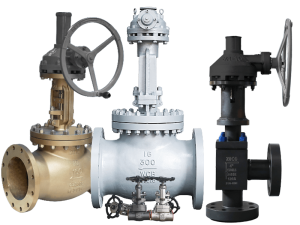
An angle valve is actually a specific type of globe valve.
A standard globe valve has an in-line, straight-through design. Fluid enters one side, flows through an S-shaped pathway, and exits the other side. Simple enough, right?
An angle valve? It takes that same concept and adds a 90-degree twist. The inlet and outlet ports are set at a right angle. This lets it double as both a valve and a pipe elbow.
The bottom line? Both configurations are great for precise flow regulation. But their structural differences determine when you should use each one.
Angle Valve vs Globe Valve: Complete Comparison
Design Differences: The Nitty-Gritty
Let’s get into the details.
Standard Globe Valve Design
A standard globe valve has a spherical body. Inside, there’s an internal baffle that divides the chamber into two parts. The flow path creates an S-shape as fluid moves around the baffle.
The inlet and outlet ports? They’re aligned on the same axis. Straight-through flow.
Angle Valve Design
With an angle valve, the inlet and outlet ports are positioned at a 90-degree angle. This creates an L-shaped flow path.
The internal components? They’re similar to standard globe valves. But the body configuration is different to handle that angled flow.
Here’s the deal: This 90-degree design means the fluid only makes one turn instead of multiple direction changes. Less turbulence. Better flow efficiency.
Key Structural Differences at a Glance
| Feature | Standard Globe Valve | Angle Valve |
|---|---|---|
| Body Configuration | Spherical, straight-through | L-shaped, 90-degree |
| Port Alignment | Inlet and outlet on same axis | Inlet and outlet at 90° angle |
| Flow Path | S-shaped, multiple turns | L-shaped, single turn |
| Pressure Drop | Higher | Lower (compared to globe + elbow) |
| Space Required | More (needs extra fittings for turns) | Less (eliminates need for elbow) |
The Flow Characteristics You Need to Know
This is where things get really interesting.
Pressure drop matters. A lot.
With a standard globe valve, you’re looking at higher pressure drops. Why? Because the fluid has to change direction multiple times as it navigates around that internal baffle. More turbulence. More energy loss.
But here’s the trade-off: that same design gives you superior throttling control.
Angle valves? They generally produce lower pressure drops. Especially when compared to a standard globe valve combined with an elbow fitting. The single 90-degree turn creates less turbulence.
In my experience, the flow coefficient (Cv) values tell the story. Angle valves typically have higher Cv values than standard globe valves of the same size. Better flow capacity.
Pro Tip: If minimizing pressure loss is critical for your system, angle valves often win this comparison.
Installation and Space Requirements
Let me share something I’ve learned from working with countless systems:
Space is almost always a consideration.
Standard globe valves require straight-line piping. Want to change flow direction? You’ll need additional fittings like elbows. That takes up more space. Creates more potential leak points. Increases pressure drop.
Angle valves? They’re a space-saving marvel.
Their integrated 90-degree design eliminates the need for a separate elbow fitting. You get a smaller installation footprint. Fewer leak points. Less pressure drop. And in cramped equipment rooms? That’s gold.
Here’s what I personally recommend: If your piping layout requires a 90-degree turn, go with an angle valve. You’ll thank yourself later.
Where Each Valve Shines
Globe Valve Applications
Standard globe valves excel at precise flow regulation. They’re ideal for:
- Process systems requiring accurate flow modulation
- Steam line throttling
- Boiler feed water regulation
- Chemical processing
- HVAC temperature control
Angle Valve Applications
Angle valves shine in specific scenarios:
- Space-constrained piping systems
- Tank and vessel bottom outlets
- Radiator connections in heating systems
- Compressed air systems
- Systems where minimizing pressure drop is critical
Maintenance Considerations
Both valve types require regular maintenance. But there are differences.
Standard globe valves have good accessibility. You can often replace packing under pressure. But seat replacement typically requires full disassembly.
Angle valves offer similar maintenance accessibility. In some configurations, they’re actually easier to work with.
The bottom line? Neither valve is maintenance-free. But both are manageable with proper planning.
Actuation Options
You’ve got options with both valve types:
- Manual actuation with handwheel operators
- Electric actuation for remote operation
- Pneumatic or hydraulic actuation for hazardous environments
The choice depends on your specific needs. Control system integration. Operational preferences. Budget constraints.
Decision Time: Angle Valve vs Globe Valve
Here’s my simple decision framework:
Go with a standard globe valve when:
- You need straight-through flow
- Precise throttling is critical
- Pressure drop isn’t a primary concern
- You have space for fittings
Go with an angle valve when:
- Your system needs a 90-degree turn
- Space is limited
- You want to minimize pressure drop
- Reducing leak points matters
Real-World Example
I worked with a chemical processing facility last year. They had a tight space constraint near a reactor vessel. The piping required a 90-degree turn.
The standard approach would have been a globe valve plus an elbow. But we went with an angle valve instead.
The result? Cleaner installation. Fewer leak points. Better flow characteristics. And the maintenance team loved it.
One More Thing
The term “angel valve” keeps popping up in discussions. Let me clear that up right now.
There’s no such thing as an “angel valve” in industrial fluid control. It’s a common misspelling of “angle valve.” Don’t let that confuse you.
Wrapping This Up
Choosing between an angle valve vs globe valve comes down to your specific situation.
Globe valves excel at precise flow regulation in straight-line configurations. Angle valves offer space savings and reduced pressure drop when you need a 90-degree turn.
Remember: Both are valuable tools. Each has strengths. The “best” choice is always the one that meets your specific requirements.
So next time you’re comparing angle valve vs globe valve, think about your piping layout. Your space constraints. Your pressure drop needs.
Make the smart choice. Your system will thank you.