- Double check valves provide basic protection for low-hazard applications, while RPZ backflow preventers offer fail-safe protection for high-risk situations.
- Local codes dictate which device you need based on hazard level – you can’t just pick whichever you want.
- The cost difference ($200-$800 for double check vs $400-$2,000+ for RPZ) becomes meaningless compared to potential $25,000+ fines for water contamination.
- When in doubt, choose the higher level of protection and consult your local water authority.
Ever stop to ask why your plumber pushes for a backflow preventer when a basic check valve looks like it should cover it? You’re not the only one. I hear this a lot from property owners trying to figure out why they’re paying extra for something that, on the surface, feels like the same thing. Simple as that.
As a professional check valve manufacturer, let me settle the double check valve vs backflow preventer argument once and for all. They look alike at first glance, sure, but picking the wrong one can actually foul your drinking water and put you on the radar of local inspectors. Not great. Simple as that.
What Exactly Is a Double Check Valve?
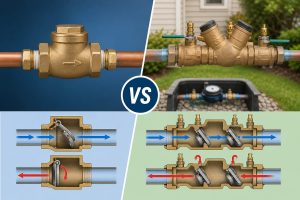
A double check valve is essentially two check valves working together in the same assembly. Think of it as a backup system where if one valve fails, the other one’s got your back.
Here’s how it works:
Two independent check valves sit in series inside a single body. When water flows in the right direction, both valves open. But if water tries to flow backward? Both valves slam shut.
Pretty simple, right?
But here’s where it gets interesting. A double check valve assembly (often called a DCVA) isn’t just two random check valves slapped together. It’s a carefully engineered device that includes:
- Two spring-loaded check valves
- Test cocks for maintenance checks
- Shut-off valves on both ends
- A specific pressure drop requirement between valves
I’ve seen double check valves work flawlessly for decades in the right applications. But they’re not bulletproof.
Backflow Preventers: The Heavy-Duty Protection
Now, when people say “backflow preventer,” they’re usually talking about a whole category of devices. And yes, technically a double check valve IS a type of backflow preventer.
(Confusing? Stay with me.)
But in the plumbing world, when someone says “backflow preventer,” they often mean the more advanced devices like:
Reduced Pressure Zone (RPZ) Assemblies: These bad boys have two check valves PLUS a relief valve. If anything goes wrong, water dumps out instead of flowing backward.
Pressure Vacuum Breakers (PVB): These use air to break any potential siphon effect.
Atmospheric Vacuum Breakers (AVB): The simplest type, using air admission to prevent backflow.
The key difference? These devices have fail-safe mechanisms that double check valves don’t.
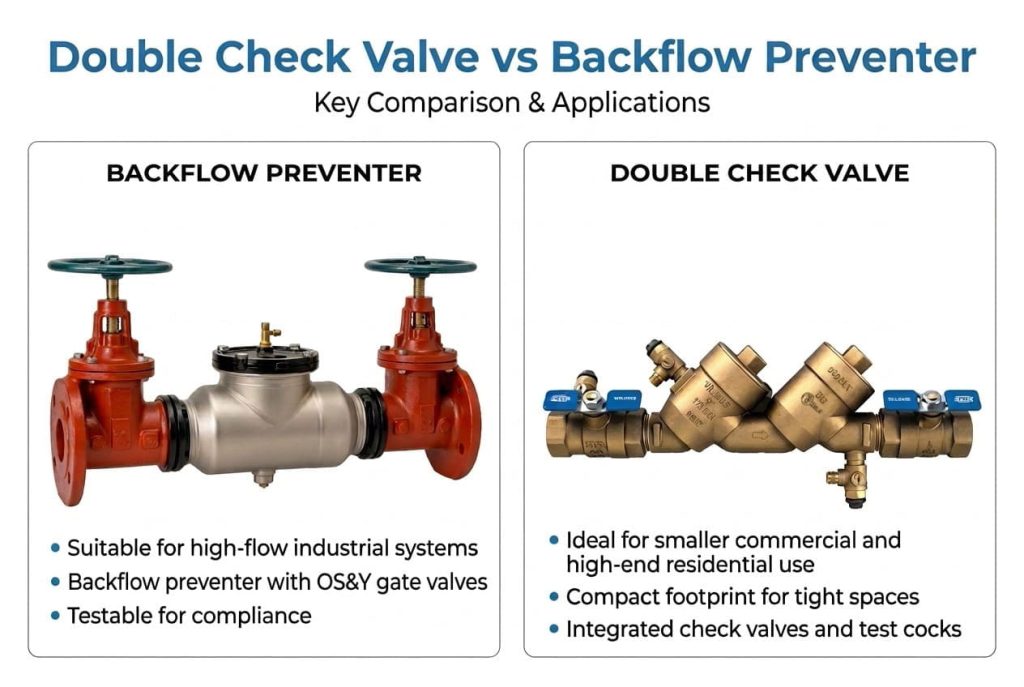
Double Check Valve vs Backflow Preventer: Critical Differences
Let’s cut to the chase. Here are the real differences between a double check valve and other backflow preventers:
Protection Level
Double Check Valve: Provides good protection against backpressure and backsiphonage. But if both valves fail (rare but possible), you’ve got zero protection.
RPZ Backflow Preventer: Even if BOTH check valves fail, the relief valve opens and dumps water. Your drinking water stays safe.
Application Requirements
I can’t stress this enough: You can’t just pick whichever device you want.
Local codes dictate which device you need based on:
- The hazard level (low, medium, or high)
- The type of cross-connection
- What’s downstream from the device
For example, in my area, irrigation systems with chemical injection MUST have an RPZ. No exceptions.
Cost Differences
Let’s talk money. Because that’s usually what this comes down to.
A double check valve assembly typically runs $200-$800 depending on size. An RPZ? You’re looking at $400-$2,000 or more.
But here’s the thing: The cost difference becomes meaningless if you contaminate the water supply. We’re talking potential fines of $25,000+ and possible criminal charges.
Maintenance Requirements
Both devices need annual testing by a certified tester. (In 2026, most jurisdictions require this.)
But RPZs are more complex to test and maintain. They also need proper drainage since they can discharge water during normal operation.
When to Use Each Device
Here’s my simple guide:
Use a Double Check Valve for:
- Fire sprinkler systems (in many jurisdictions)
- Low-hazard irrigation systems without chemicals
- Closed-loop heating/cooling systems
- Industrial processes with non-toxic materials
Use an RPZ (or other high-protection backflow preventer) for:
- Irrigation systems with chemical injection
- Medical facilities
- Processing plants with toxic materials
- Any high-hazard cross-connection
Pro Tip: When in doubt, go with the higher level of protection. I’ve never seen someone get in trouble for over-protecting the water supply.
Real-World Example: The $50,000 Mistake
Let me share a quick story. Last year, a property manager I know tried to save $1,200 by installing a double check valve instead of an RPZ on their irrigation system.
The problem? They were using fertigation (fertilizer injection). The water authority caught it during a routine inspection.
The result:
- $15,000 fine
- Immediate system shutdown
- $3,000 to replace with proper RPZ
- Legal fees
- Damaged reputation
Total cost of trying to save $1,200? Over $50,000.
Installation Considerations
Whether you’re installing a double check valve or an RPZ, placement matters.
Both devices should be:
- Accessible for testing and maintenance
- Protected from freezing
- Installed horizontally (usually)
- At least 12 inches above ground/floor
But RPZs have an extra requirement: proper drainage.
Since RPZs can discharge water, you need a drain capable of handling the full flow rate. I’ve seen RPZs flood mechanical rooms because someone forgot about drainage.
The Testing Protocol
Annual testing isn’t optional. It’s required by law in most areas.
The testing process involves:
- Checking static pressure across each check valve
- Verifying proper operation of all components
- Documenting everything for regulatory compliance
Testing a double check valve takes about 20-30 minutes. An RPZ? Plan on 45-60 minutes.
Common Misconceptions
Let me clear up some confusion I see all the time:
“A check valve is the same as a backflow preventer”
Wrong. A single check valve provides minimal protection. Even double check valves are considered “low hazard” protection only.
“I don’t need permits for backflow preventers”
Almost always false. Most jurisdictions require permits AND inspection.
“Backflow preventers last forever”
Nope. Plan on 15-30 years with proper maintenance. Less if you have aggressive water.
Making the Right Choice
So how do you decide between a double check valve and other backflow preventers?
Start with these questions:
- What does your local code require?
- What’s the hazard level of your application?
- What’s your budget (including long-term costs)?
- Can you handle the maintenance requirements?
Remember: The most expensive backflow preventer is the one that fails when you need it.
The Bottom Line
The double check valve vs backflow preventer decision isn’t really yours to make. Local codes and the application determine which device you need.
But understanding the differences helps you:
- Avoid costly mistakes
- Protect public health
- Stay compliant with regulations
- Make informed decisions about your plumbing systems
Double check valves work great for low-hazard applications. But when the stakes are high? You need the fail-safe protection of an RPZ or other advanced backflow preventer.
Don’t gamble with water safety. When in doubt, consult a certified tester or your local water authority. The peace of mind is worth way more than any money you might save.
Because at the end of the day, protecting our water supply isn’t just about following rules. It’s about keeping people safe. And that’s something we can all get behind.