Quick Summary:
- Picking the cheaper valve isn’t just about the sticker price—it depends heavily on size, pressure, and hidden costs. Ball valves are more cost-effective at 2 inches and under, while butterfly valves run 30–70% cheaper at 6 inches and above.
- Watch for actuator sizing, weight, and installation costs: butterfly valves need less torque and weigh far less in large sizes, compounding your savings.
- Choose ball valves for high-pressure, zero-leakage, or pigging service; choose butterfly valves for large diameters, tight spaces, throttling, and budget-sensitive projects.
You’re speccing a new process line. Pipe size is 10 inches. You need shutoff valves. Your boss asks for ball valves because “that’s what we’ve always used.” Then procurement gets the quote for ball valve vs butterfly valve cost and nearly falls out of their chair.
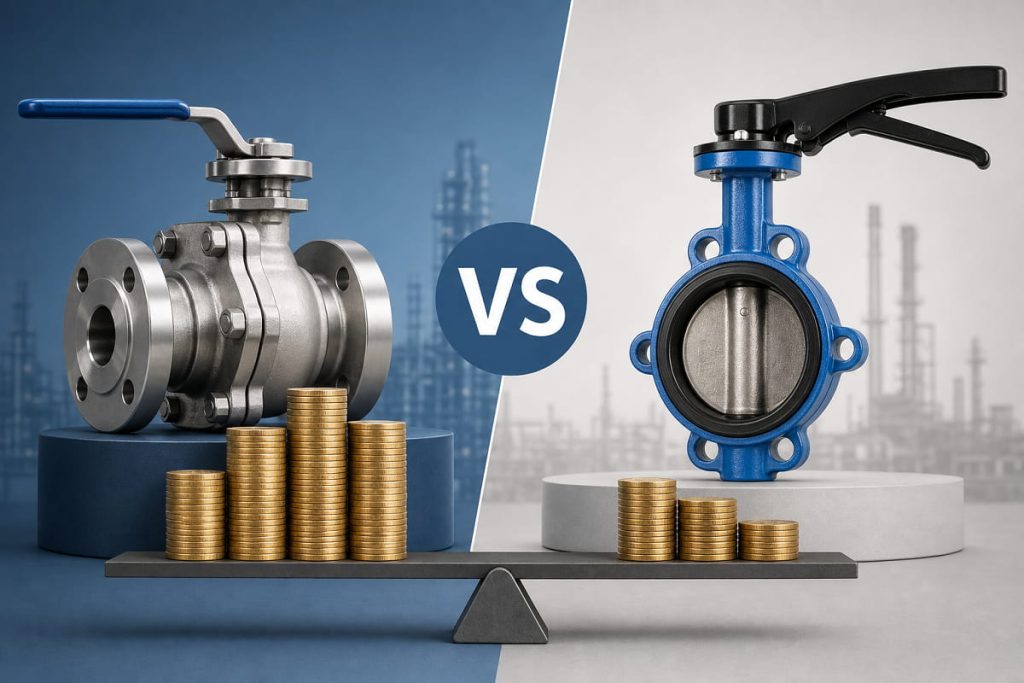
The cost difference can be brutal. Butterfly valves are generally 30% to 70% cheaper at 6 inches and above—a 24-inch butterfly valve runs $200–$500 while an equivalent ball valve hits $800–$1,500 or more. But the sticker price is only the start. Actuation, weight, installation, and maintenance can flip your decision completely.
In this guide,as a professional ball valve and butterfly valve manufacturer, I will break down size-by-size pricing, the hidden costs that blow budgets, and a simple decision framework to help you choose the valve that saves money without creating problems down the line.
Ball Valve vs Butterfly Valve Cost: The Short Answer
Small valves (2 inches and under): Ball valves usually win.
They cost less upfront. They’re easy to source. And they give you a rock-solid seal for residential or light commercial plumbing.
Large valves (6 inches and up): Butterfly valves dominate.
Industry data shows butterfly valves are generally 30% to 70% cheaper than ball valves in larger pipe sizes. And that gap only gets bigger as the pipe grows.
Here’s a real example that makes people’s eyes pop: a 24-inch butterfly valve typically costs $200–$500. A 24-inch ball valve? Anywhere from $800 to $1,500 or more. Ouch.
Why Sticker Price Isn’t the Whole Story
Here’s the deal: the price on the quote is just the beginning.
I’ve watched procurement teams celebrate saving money on the valve body, only to blow the budget on actuators, pipe supports, and installation labor. That’s why you need to think about total cost of ownership, not just the purchase price.
The bottom line? The smart choice comes from looking at the full picture.
Ball Valve vs Butterfly Valve Cost by Size
Small Diameters (2 Inches and Under)
If you’re working with small pipes, stop overthinking.
For a ½-inch or 1-inch shutoff, a ball valve is your best bet. It’s compact, reliable, and affordable. A typical residential ball valve runs $15–$30. A butterfly valve at that size? They exist, but they’re not common. And they don’t give you the same tight seal.
I personally recommend ball valves for:
- Home plumbing shutoffs
- Appliance hookups
- Small pump lines
- Applications where you need a reliable on/off valve
Medium Diameters (3 to 6 Inches)
This is the gray zone.
At 3 and 4 inches, prices overlap. You can find cheap ball valves and expensive butterfly valves. My rule of thumb? If you need tight shutoff and high pressure, go ball. If you need to throttle flow or save space, go butterfly.
Large Diameters (6 Inches and Up)
This is where butterfly valves crush it.
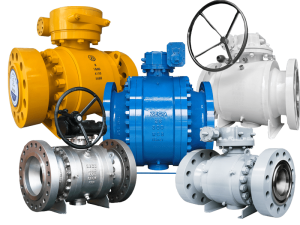
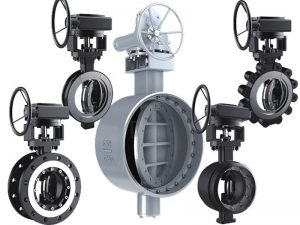
The amount of raw material in a large ball valve is insane. You’ve got a massive sphere, thick walls, and heavy flanges. A butterfly valve is basically a thin disc in a slim ring. Less material. Less machining. Less cost.
Here’s what I’m seeing in 2026 quotes:
| Valve Size | Typical Ball Valve Cost | Typical Butterfly Valve Cost | Savings |
|---|---|---|---|
| 6″ | $300–$700 | $150–$350 | 30–50% less |
| 12″ | $1,500–$3,000 | $400–$800 | 60–70% less |
| 24″ | $800–$1,500+ | $200–$500 | 70%+ less |
(Note: Prices vary by pressure class, material, and manufacturer. Always get real quotes.)
The Hidden Costs That Flip the Decision
Here’s where most people get tripped up. The valve body is only one piece of the puzzle. Let’s walk through the other costs.
1. Actuation and Torque
If your valves are automated, listen up.
Butterfly valves require less torque to turn. The disc sits inside the flow stream, so it doesn’t have to fight as much pressure. That means you can buy smaller, cheaper electric or pneumatic actuators.
Ball valves? They need much higher torque, especially as they get bigger. A large ball valve might need a massive actuator and a gearbox. I’ve seen actuation costs double or triple the total price of a valve setup.
Pro Tip: Always price the valve and actuator together. A cheap valve with an expensive actuator isn’t a bargain.
2. Installation and Weight
A 12-inch flanged ball valve can easily weigh 1,100 pounds. A 12-inch wafer butterfly valve? Maybe 120 pounds. That’s a massive difference.
That weight affects:
- Shipping costs
- Crane or rigging requirements
- Structural steel supports
- How many technicians you need on-site
Butterfly valves also have a much shorter face-to-face dimension. A 6-inch butterfly valve might be about 2 inches wide. A 6-inch flanged ball valve? Closer to 16 inches. In a tight piping rack, that can make or break the design.
3. Maintenance and Lifespan
Here’s the part that surprises people.
Ball valves are tough. They handle high pressure and gritty materials better than butterfly valves. In severe industrial environments, a ball valve can save you money over time because it doesn’t leak as easily.
Butterfly valves are simpler and easier to maintain. But their seats and discs can wear faster in demanding service. That’s why you need to consider maintenance costs and replacement costs, not just the initial price.
4. Downtime
What’s a valve failure worth to you?
If a valve fails and shuts down an entire plant, the cost is astronomical. In critical processes, I usually pay more upfront for a ball valve because the reliability is worth it. In non-critical water lines? A butterfly valve is fine.
Why Some People Say “Butterfly Valves Leak”
I hear this all the time from plant managers. “Butterfly valves leak. Stick with ball valves.”
In my experience, that’s usually because someone used the wrong butterfly valve for the job. A resilient-seated butterfly valve works great for clean water at moderate pressure. But if you slap it into a high-pressure steam line or abrasive slurry service, yeah, it’s going to leak.
That’s why you need to look at the valve’s design and pressure rating. High-performance double offset and triple offset butterfly valves are a different beast. They use metal seats and can handle much higher pressures and temperatures. They’re more expensive than a basic wafer valve, but still cheaper than a big ball valve in many cases.
The point is: don’t ban a valve type based on one bad experience. Match the valve to the service.
When a Ball Valve Is Worth the Extra Money
Let’s not cheap out on the wrong things. Here’s when I tell clients to pay the premium for a ball valve:
- High-pressure systems (Class 600 and above)
- Bubble-tight shutoff for gas or hazardous fluids
- Pigging operations where you need a full-bore opening
- Zero-leakage requirements in chemical processing
- Frequent cycling where seal integrity is critical
- Pump suction lines where turbulence can cause cavitation
In these cases, the extra cost is insurance. And insurance is worth it.
When a Butterfly Valve Makes More Sense
Now let’s talk about when a butterfly valve is the smart play.
- Large-diameter pipes (6 inches and above)
- Space-constrained installations
- Throttling and flow control (butterfly valves handle partial opening well)
- Budget-sensitive projects with moderate pressure
- Water, wastewater, HVAC, and cooling water services
And if you need a dead-end service, just spec a lug-style butterfly valve instead of a wafer style. Easy fix.
Real-World Examples
Example 1: Homeowner Shutoff Valve
You need a valve under a kitchen sink. Pipe is ½ inch. Pressure is normal. You want something that won’t leak. Ball valve. It costs $20, installs in minutes, and seals tight for decades.
Example 2: Municipal Water Plant
You’re installing a 24-inch isolation valve in a water main. Space is tight. Budget is tight. Pressure is moderate. Butterfly valve. It’s thousands of dollars cheaper, weighs a fraction of a ball valve, and handles the job perfectly.
Example 3: Chemical Processing Line
You’re handling a hazardous solvent at high pressure. A leak means a safety incident. Ball valve. The upfront pain of a heavy, expensive valve beats the unthinkable cost of a failure.
My Simple Decision Framework
Here’s the process I use with my own clients. You can steal it.
- 1. What’s the pipe size? Under 2 inches? Ball. Over 6 inches? Lean butterfly.
- 2. What’s the pressure? High? Ball. Moderate? Either works.
- 3. Do you need throttling? Yes? Butterfly. On/off only? Ball.
- 4. How much space do you have? Not much? Butterfly.
- 5. Will it be automated? Factor in actuator costs. Butterfly often wins.
Sound good? Great. Now let’s wrap this up.
Bottom Line
There is no universal winner in the ball valve vs butterfly valve cost debate. It all depends on your application.
- Small pipes: Ball valves are more cost-effective and practical.
- Large pipes: Butterfly valves can save you 30% to 70% or more.
- Critical service: Ball valves justify their premium.
- Big water/HVAC jobs: Butterfly valves are the smart financial move.
So don’t just ask “which valve is cheaper?” Ask “which valve costs less over the life of my system?” That’s the real ball valve vs butterfly valve cost.