Quick Summary:
- Full port ball valves have a bore equal to the pipe diameter, giving you maximum flow with zero pressure drop. Standard port valves have a smaller bore (usually one pipe size down), causing some flow restriction and a measurable pressure drop, but they’re cheaper and more compact.
- In most applications, a standard port valve works perfectly fine — the slight pressure drop is often negligible compared to other system components. However, full port is non‑negotiable when you’re handling solids or slurries, working on pump suction/discharge lines, or trying to avoid cavitation.
- Choose standard port when budget or space is tight; choose full port when maximum flow, low resistance, or solids handling is critical.
You’re standing in the supply aisle, pipe wrench in hand, staring at two nearly identical ball valves. One costs twice as much. The other looks smaller but fits your budget. Which one do you pick? The wrong choice can cost you performance, waste money, or even damage your pump through cavitation.
Today as a professional ball valve manufacturer, I’m going to break down the ball valve standard vs full port debate. I will straight talk about what matters for your specific situation. We’ll cover the core differences in bore size, flow restriction, pressure drop, cost, and physical size. Then I’ll show you exactly when to use each type so you never second‑guess your decision again.
What’s Actually Happening Inside a Ball Valve?
Here’s a quick refresher (stick with me, this is important):
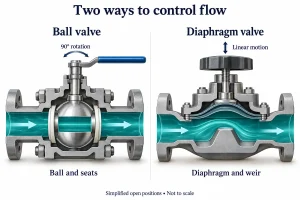
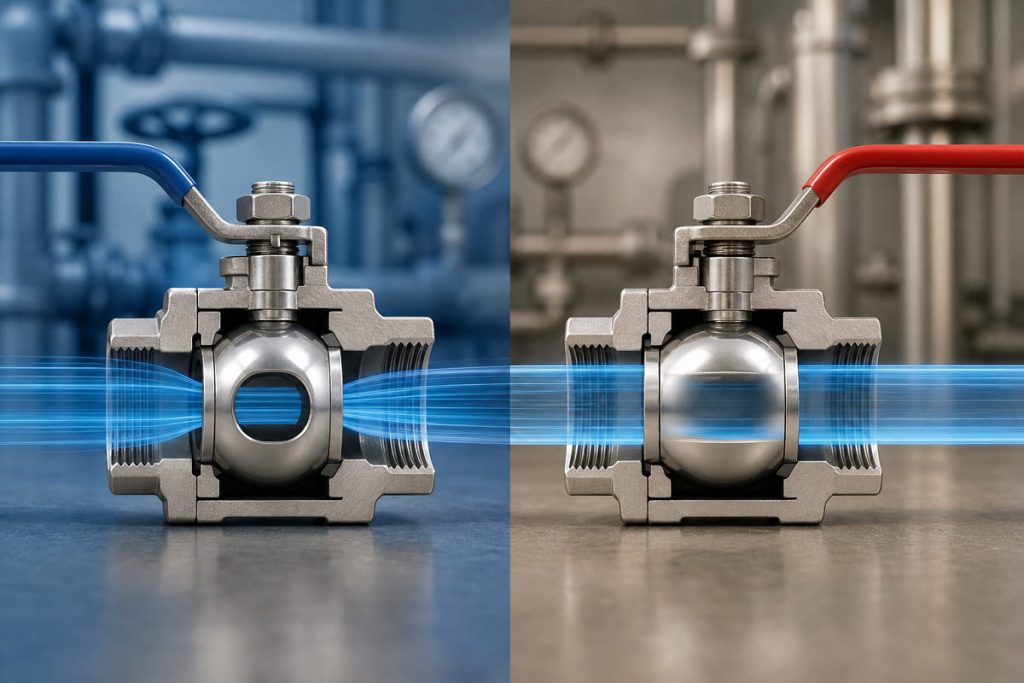
A ball valve has a rotating sphere inside. That sphere has a hole (called the “bore”) through the middle. When the handle turns parallel to the pipe, the hole lines up and flow passes through. Turn it perpendicular, and you’ve got a shut-off.
Simple, right?
The difference between a full port and standard port ball valve comes down to one thing: the size of that hole.
Full port: The bore is the same diameter as your pipe. Flow passes through without any restriction. Zero. Nada.
Standard port: The bore is smaller than your pipe. Usually one pipe size smaller. So some restriction happens.
That’s it. That’s the fundamental difference.
Ball Valve Standard vs Full Port: The Core Differences
Let me lay this out in plain English.
Flow Restriction
Full port = maximum flow. The liquid or gas passes through like the valve isn’t even there.
Standard port = some restriction. You’ll get a pressure drop. Not massive, but it exists.
Here’s a real-world example:
Imagine you’re drinking through a straw. A full port valve is like using a smoothie straw. Wide open. Nothing slows you down.
A standard port valve? That’s like using one of those skinny coffee stirrer straws. You can still drink. But you’re working harder to get the same amount through.
Pressure Drop
This is where things get technical. But I’ll keep it simple.
Pressure drop = energy lost.
Full port valves cause almost zero pressure drop. Standard port valves cause a measurable pressure drop. The smaller bore forces the fluid to speed up as it squeezes through, then slow back down on the other side.
That speed change? It costs you energy.
Pro Tip: If you’re dealing with a pump suction line, go full port. A pressure drop there can mess up your pump’s performance. I’ve seen it happen. Not pretty.
Physical Size and Weight
Standard port valves are more compact. Smaller body. Lighter weight.
Full port valves need a larger body to fit that larger ball. More material. More weight.
This matters when space is tight. I’ve had projects where a standard port valve was the only option because the full port simply wouldn’t fit in the available space.
Cost
Here’s the bottom line:
Full port = more expensive. More material, larger casting, higher manufacturing cost.
Standard port = cheaper. Sometimes significantly.
How much cheaper? It depends on the size and material. But for a typical 1-inch brass ball valve, you’re looking at maybe 20-40% savings with standard port.
Debris and Solids Handling
This one’s critical:
If your system carries thick fluids, slurries, or solid particles, go full port.
Why? Because the full-size bore lets everything pass through without getting stuck. Standard port valves have that smaller opening. Debris can build up at the restriction point. Over time, that buildup affects performance.
I’ve seen standard port valves in slurry applications fail completely because of clogging. Full port? No problem.
Quick Comparison Table
| Feature | Full Port | Standard Port |
|---|---|---|
| Bore size | Same as pipe | One size smaller |
| Flow restriction | None | Some (pressure drop) |
| Cost | Higher | Lower |
| Size | Larger body | Compact |
| Solids handling | Excellent | Poor |
| Weight | Heavier | Lighter |
| Cavitation risk | Low | Higher |
When Should You Use Full Port Valves?
OK, let’s get practical.
Use full port when:
1. Maximum flow is critical. If your system can’t afford any pressure drop, full port is your only option.
2. You’re on a pump suction or discharge line. This is huge. A pressure drop here can cavitate your pump. Cavitation destroys pumps. Trust me, I’ve replaced enough of them.
3. The fluid contains solids. Slurries, thick liquids, anything with suspended particles. Full port prevents clogging.
4. You need to “pig” the line. Pipeline pigs (cleaning devices) need full bore to pass through. Standard port won’t work.
5. Low turbulence is required. Some systems are sensitive to flow disturbance. Full port gives you the cleanest flow path.
6. Clean-in-place (CIP) systems. Full port valves are easier to clean internally. No crevices for bacteria to hide.
When Should You Use Standard Port Valves?
Here’s the thing: standard port valves aren’t bad. They’re just designed for different situations.
Use standard port when:
1. Budget is tight. Standard port is the economical choice. You save money upfront.
2. Space is limited. Full port valves are bigger. If you’re squeezing into a tight cabinet or panel, standard port might be your only option.
3. The application doesn’t need full flow. Most residential plumbing, HVAC systems, and general industrial applications don’t need max flow through every valve.
4. Slight pressure drop is acceptable. In most systems, the overall piping layout creates more resistance than a standard port valve ever could. The valve isn’t your bottleneck.
5. You’re working on non-critical systems. Temporary setups, chemical plants, general plumbing. Standard port does the job.
6. High turnover applications. You’re cycling the valve frequently but don’t need premium performance.
Here’s a truth bomb: In the vast majority of applications, a standard port valve works just fine.
I’m serious. Most engineers over-spec full port valves because they think “more is better.” But in practice, the difference in overall system performance is often negligible.
Does Port Size Really Affect Flow That Much?
Let me share a quick case study from my experience.
A few years back, I worked with a facility that had standard port ball valves on their cooling water lines. The maintenance team was convinced the valves were causing flow problems. They wanted to swap everything to full port.
We tested it. Measured flow rates before and after the switch.
The result? Less than 2% improvement.
Why? Because the system had long pipe runs, multiple elbows, and other components that created way more resistance than those standard port valves ever did.
The valve wasn’t the bottleneck. The piping system was.
The bottom line? Unless your system is short with minimal bends and fittings, a standard port valve’s flow restriction is probably not your biggest problem.
Cavitation Risk: What You Need to Know
This is a topic that doesn’t get talked about enough.
Cavitation happens when liquid pressure drops so fast that vapor bubbles form. Those bubbles collapse. And when they collapse near metal surfaces? They erode the material.
Standard port valves create more pressure drop. More pressure drop = higher cavitation risk.
Full port valves? Almost zero pressure drop. Minimal cavitation risk.
If your system operates at high pressure or has rapid pressure changes, this matters. A lot.
I’ve seen ball valves destroyed by cavitation in less than six months. The ball and seat looked like someone took a sandblaster to them.
Moral of the story: If cavitation is a concern, go full port.
Bore Size: Let’s Get Specific
Let me clear up some confusion about bore sizes.
A 3/4-inch full port ball valve has a 3/4-inch bore. The ball opening matches the pipe diameter.
A 3/4-inch standard port ball valve typically has a 1/2-inch bore. The ball is sized for the next smaller pipe size.
Simple rule: Standard port bore = one pipe size down.
Why do manufacturers do this? Two reasons:
1. Compact design. Smaller ball, smaller body, less space needed.
2. Lower cost. Less material, easier to manufacture.
That’s why standard port valves are more common. They’re practical and economical.
Final Verdict: Ball Valve Standard vs Full Port
Here’s my take:
Choose full port when flow rate is critical, you’re handling solids, or cavitation is a real risk. Pay the premium. It’s worth it.
Choose standard port when budget matters, space is tight, or your system can tolerate a slight pressure drop. You’ll save money and it’ll work great.
Most of the time? Standard port is the right call.
But there are specific situations where full port is non-negotiable. Know your system. Know your fluid. Make the smart choice.
Hopefully this clears up the ball valve standard vs full port confusion. If you’re still unsure, drop a comment below. I’m happy to help you figure out what’s best for your specific application.