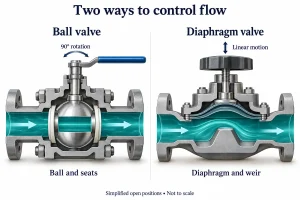
The key difference in Ball Valve vs Diaphragm Valve is how they stop flow: a ball valve rotates a ball with a hole through it, while a diaphragm valve presses a flexible membrane against a seat. Choose a ball valve for low-resistance isolation and suitable high-pressure duties; choose a diaphragm valve when separating the operating mechanism from the fluid, hygienic processing, or compatible chemical service is the priority.
| Selection factor | Ball valve | Diaphragm valve |
|---|---|---|
| Closing mechanism | A bored ball rotates 90 degrees. | A diaphragm moves onto a weir or body seat. |
| Typical strength | On/off isolation with high flow capacity. | Fluid isolation from the stem and operating mechanism. |
| Flow regulation | Use a purpose-designed control version for sustained throttling. | Suitable designs can regulate flow; sizing and actuator selection matter. |
| Pressure and temperature | High-pressure and extreme-temperature versions are available. | Conventional process versions are often limited by diaphragm and body materials. |
| Pressure loss | A full-port design usually offers low resistance when fully open. | Depends on geometry; a weir generally adds flow resistance. |
| Hygienic service | Special sanitary designs exist; cavity cleaning needs attention. | Widely used in aseptic systems when correctly specified and installed. |
| Solids and slurry | Specialized designs can handle solids; seats and cavities need review. | Straight-through designs can suit slurries; abrasive particles can damage the diaphragm. |
| Maintenance focus | Seats, stem seals, body seals, ball, and actuator. | Diaphragm condition, sealing surfaces, fasteners, and actuator. |
Treat this table as a shortlist. The final choice comes down to the exact valve, materials, and operating conditions.
A utility water line and a sterile product line can have the same pipe size and need very different valves. Start with the job the valve must do.
How Ball Valves and Diaphragm Valves Work
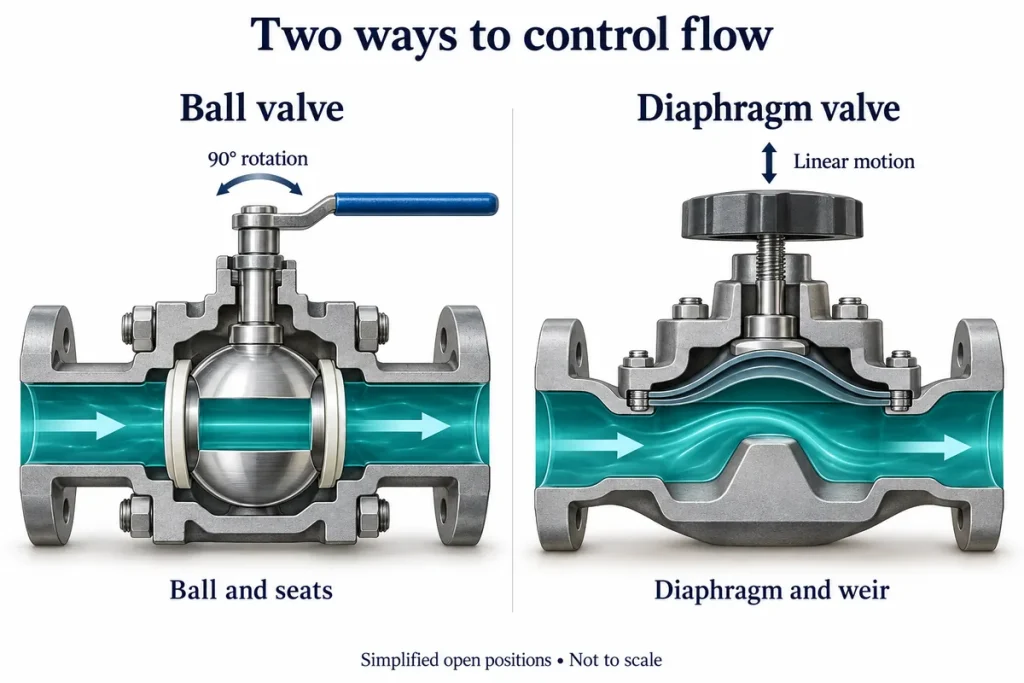
Ball valves control flow with rotary movement; diaphragm valves use a flexible barrier that moves toward or away from a sealing surface. That difference affects flow resistance, cleaning, and which components touch the process fluid.
Ball Valves: A Quarter Turn Opens or Closes the Flow Path
A ball valve opens when the hole through its ball lines up with the pipe and closes when the ball rotates across the flow path. The movement between fully open and fully closed is normally 90 degrees.
A full-port ball valve has a bore sized to provide a relatively unrestricted passage. A reduced-port version has a smaller opening, which changes its flow capacity and pressure loss. ZECO’s guide to full-bore and reduced-bore ball valves explains these construction differences.
Fluid contacts the body, ball, seats, and other wetted components. Stem seals help prevent fluid from escaping around the shaft that turns the ball.
This design makes a ball valve a strong starting point for clean water, compressed air, and many industrial isolation duties. The materials and ratings still have to match the service.
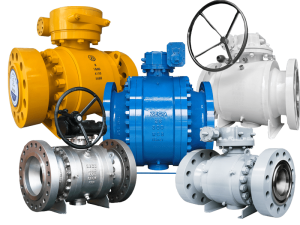
ZECO’s industrial ball valve range provides examples of floating, trunnion-mounted, and other configurations to compare once you have defined the duty.
Diaphragm Valves: A Flexible Barrier Seals the Passage
A diaphragm valve closes when its actuator or handwheel pushes a diaphragm against the valve body’s sealing surface. The diaphragm separates the process fluid from the stem and operating mechanism during normal operation.
The body or body lining still touches the fluid. A chemically resistant diaphragm cannot protect an incompatible wetted body.
Two common process designs are worth knowing:
- Weir-type diaphragm valves close against a raised ridge inside the body. Suitable versions support shutoff and flow regulation.
- Straight-through diaphragm valves provide a more open passage and can suit viscous fluids or slurries, subject to the manufacturer’s limits.
This guide focuses on these process valves. Specialized metal-diaphragm valves used in high-purity gas systems have different construction and operating limits.
Which Valve Is Better for Shutoff and Flow Control?
A standard ball valve is usually a strong choice for on/off isolation, while a properly sized diaphragm valve can handle shutoff and modulation. For demanding flow control, compare actual control-valve designs and their performance curves.
For Isolation, Start With a Ball Valve
A ball valve offers straightforward shutoff and, in a full-port design, low resistance when fully open. That combination is useful when the valve spends most of its time completely open or completely closed.
Picture a cooling-water branch that needs isolation during maintenance. You want adequate flow during production and dependable closure during a shutdown. A correctly rated ball valve often fits that job well.
Fast closure is not always the goal, though. Closing a liquid line too quickly can create a pressure surge, often called water hammer. Select the closing speed for the piping system.
Also, a closed handle does not prove that downstream equipment is depressurized. Isolation and verification procedures still apply.
For Throttling, Check the Valve’s Designed Operating Range
A diaphragm valve can regulate flow when its diaphragm, body geometry, and actuator suit the required duty. A standard isolation ball valve should not automatically be used for continuous throttling because high local velocity can damage its seats and sealing surfaces.
There is an important exception: ball valves specifically engineered for control.
For example, Emerson’s Fisher Vee-Ball V150 control valve uses a contoured ball to provide a modified equal-percentage flow characteristic. That is a deliberate control feature.
Ask the supplier for the usable flow range, permitted differential pressure, and control performance. A valve that passes maximum flow may still perform poorly at your minimum flow rate.
Compare Pressure and Temperature at the Same Time
Ball valves are available for substantially higher pressures than many conventional process diaphragm valves, but neither valve family has one universal rating. The approved pressure depends on temperature, size, materials, connections, and configuration.
Two manufacturer examples make this concrete:
- The Swagelok 60 Series product range includes ball-valve options with pressure ratings up to 3,000 psig (206 bar).
- The GEMÜ 650 BioStar product page lists 0–10 bar operating pressure, −30 to 130°C media temperature, and a separate maximum sterilization temperature of 150°C.
These are product-family summaries, not interchangeable operating envelopes. They do not mean every configuration supports every listed maximum at the same time.
For your application, get the pressure-temperature curve for the exact assembly. Include startup, shutdown, cleaning, steam exposure, and possible vacuum conditions.
Pro Tip: Put normal operating conditions and cleaning conditions on separate lines in your valve specification. A valve can handle the product and still be unsuitable for the cleaning cycle.
Compare Pressure Drop Using Flow Capacity
A fully open full-port ball valve usually offers low pressure drop, while a weir-type diaphragm valve often creates more resistance. Use the manufacturer’s flow coefficient, Cv or Kv, to compare specific valves at the flow you need.
Pipe size alone will not tell you enough.
Two valves with identical connections can have different internal passages. One may pass your required flow comfortably. The other may consume too much of the available pressure.
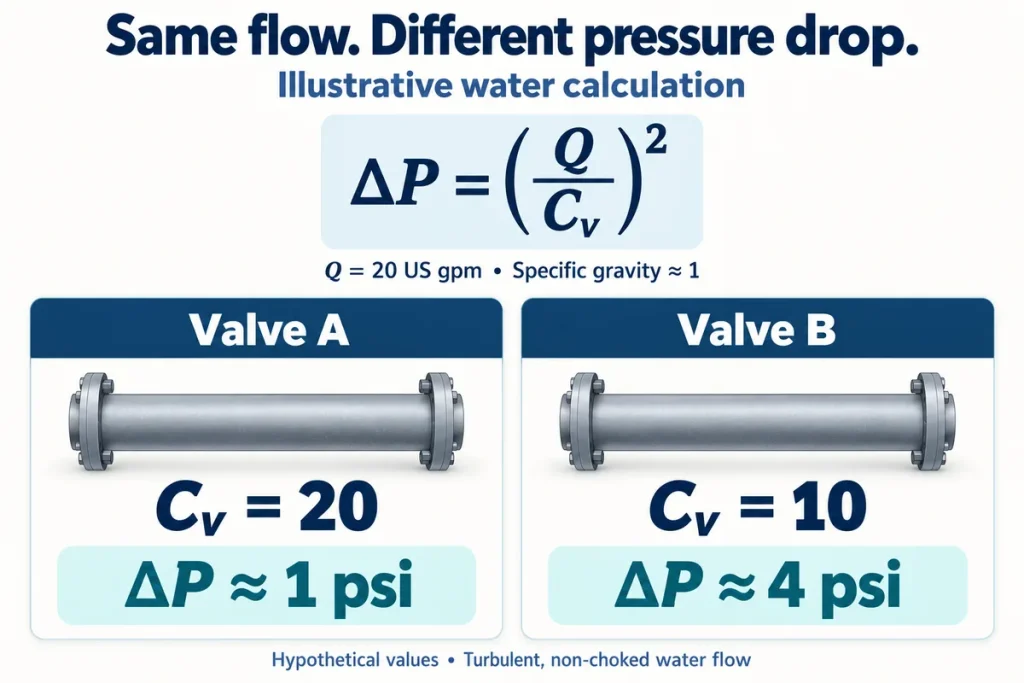
Here is a simplified worked example for water, using hypothetical valve data:
- Required flow: 20 US gallons per minute.
- Valve A: Cv = 20.
- Valve B: Cv = 10.
For non-choked, turbulent water flow with specific gravity approximately 1, the basic relationship is pressure drop in psi = (flow in US gpm ÷ Cv)².
Valve A gives approximately 1 psi of pressure drop. Valve B gives approximately 4 psi at the same flow.
That fourfold difference comes from the assumed Cv values. It is not a measured performance claim about all ball or diaphragm valves.
Use a sizing method appropriate to your fluid. Swagelok’s Cv calculator distinguishes liquid and gas calculations and accounts for additional process inputs. Viscous liquids, flashing, cavitation, and compressible gases need more than the simple water example.
For a control valve, also check performance at partial opening. The largest available Cv is not automatically the best choice for stable regulation.
Match Materials to Chemicals, Solids, and Cleaning Fluids
Chemical compatibility depends on every wetted material and the actual exposure conditions. Neither stainless steel nor a PTFE diaphragm makes a valve suitable for every chemical.
Corrosive Fluids: Check the Entire Wetted Assembly
A lined diaphragm valve can be a good candidate for corrosive service when both its lining and diaphragm are compatible with the fluid. Ball valves can also handle corrosive chemicals with suitable alloys, polymers, linings, and seals.
Write down the chemical name, concentration, temperature, pressure, and contaminants before comparing materials. Include cleaning chemicals and any mixtures that form during changeovers.
Diaphragm and seal options may include EPDM, PTFE, and FKM, but those labels are only a starting point. Compound formulation, backing layers, permeation, and repeated flexing can affect suitability.
I recommend asking for written compatibility confirmation for the complete valve configuration. A general chemical-resistance chart helps you shortlist materials; it does not settle every service condition.
Slurries and Viscous Liquids: Look at the Passage and Wear Points
A straight-through diaphragm valve can suit certain slurries, while a suitably designed full-bore ball valve can handle viscous or particle-containing fluids. Particle size, hardness, shape, concentration, and velocity determine which design deserves a closer look.
Sharp particles can damage a diaphragm. Solids can also collect around ball-valve seats or interfere with closure.
For abrasive or hotter service, metal-seated ball valves are another design to evaluate. Confirm the ball coating, seat materials, leakage requirements, and operating limits for the actual medium.
The useful questions are practical: Can the particles pass through? Will solids settle when flow stops? Can the valve close after the material has sat in the line?
For thick products, assess cleaning and product recovery too. A full-bore valve may support pigging, where a device travels through the pipe to push out residual product, provided the complete piping arrangement is designed for it.
Which Valve Is Better for Hygienic and Aseptic Processing?
A sanitary diaphragm valve is often a strong candidate for aseptic processing because its diaphragm separates the operating mechanism from the product. Hygienic ball valves also exist, and suitability depends on cleanability, drainability, materials, and the validated process.
A diaphragm valve does not create sterility by itself.
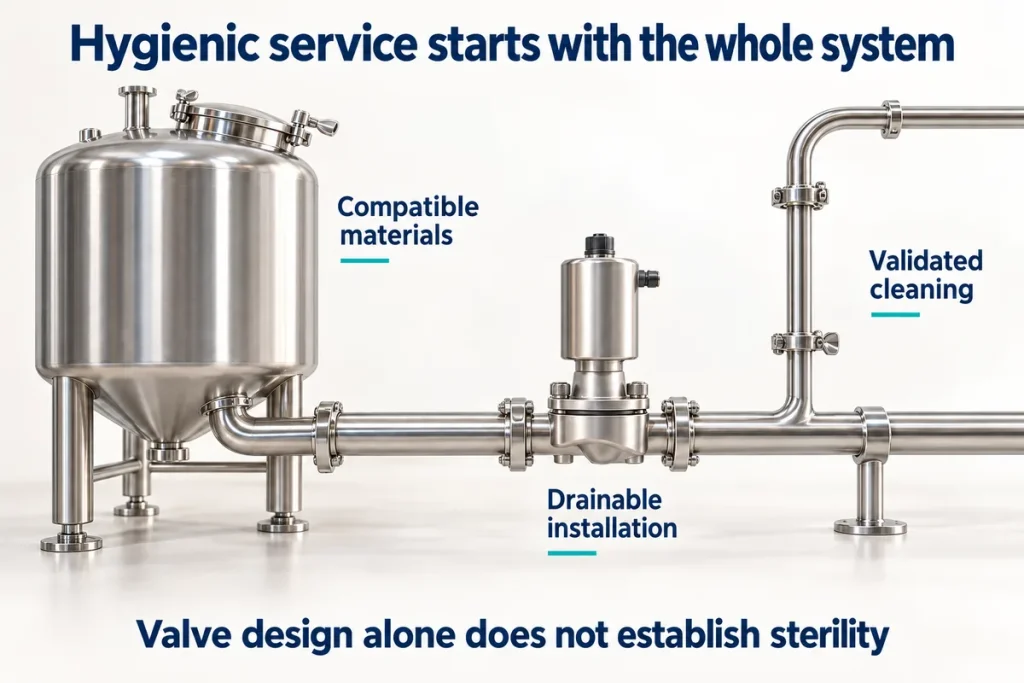
For a pharmaceutical or food application, review:
- Wetted surface finish and material traceability.
- Diaphragm and seal documentation.
- Drainability in the installed orientation.
- Crevices, dead legs, and retained product.
- Compatibility with clean-in-place (CIP) and steam-in-place (SIP) procedures.
- Applicable hygienic certifications and their scope for the exact configuration.
GEMÜ identifies the 650 BioStar as CIP/SIP capable. You still need to confirm the selected materials and permitted cleaning conditions.
Ball valves deserve a fair assessment here. Alfa Laval’s SBV sanitary ball valve is designed for hygienic applications and offers options such as encapsulated seats and valve-seat cleaning connections.
That product is a clear reason to avoid the claim that ball valves can never be used in food or pharmaceutical processing.
Buy documented cleanability for your process. A material compliance statement alone does not validate an entire valve installation or establish that a cleaning cycle works.
Compare Maintenance and Total Ownership Cost
Ball valves and diaphragm valves both need maintenance, and neither has a universal service-life advantage. Compare the actual wear parts, access requirements, operating conditions, and cost of taking the line out of service.
A diaphragm is a wear component. Chemical attack, flexing, temperature cycling, and installation can all affect its life. Set inspection and replacement intervals using manufacturer guidance and your operating records.
Ball valves can require seat, packing, stem-seal, or body-seal replacement. Repairability varies: some three-piece ball valve designs provide useful access, while other constructions require more extensive removal or replacement.
Do not assume diaphragm replacement always takes a few minutes. The complete task may include isolation, draining, decontamination, reassembly, leak testing, and process requalification.
Use this comparison:
Total ownership cost = purchase and installation + maintenance parts and labor + downtime + cleaning and validation + energy costs.
For clean utility service, a standard ball valve may be economical. For a critical hygienic process, access for inspection and reliable cleaning may justify a more expensive assembly.
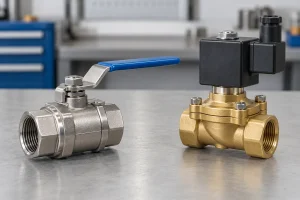
Compare equivalent specifications. A small manual brass valve and an automated sanitary valve are solving different problems, so their prices tell you very little about the relative value of the two valve types.
Choose the Right Valve in Five Steps
Select the valve by documenting the duty, checking materials and ratings, sizing for flow, confirming control behavior, and reviewing maintenance. This sequence turns a broad comparison into a specification a supplier can evaluate.
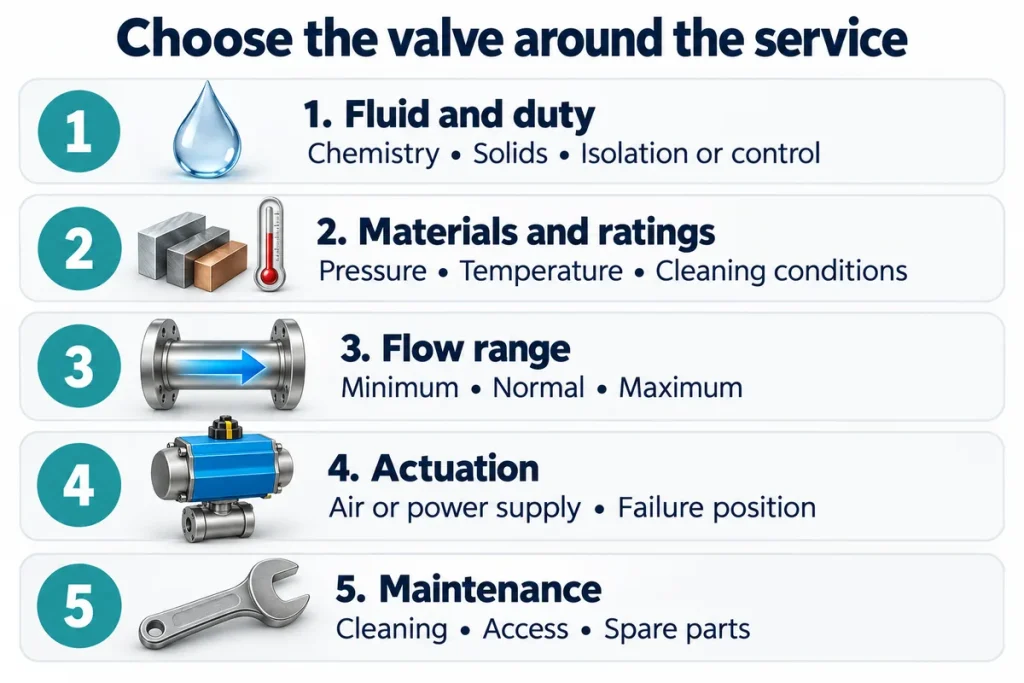
1. Define the Fluid and the Job
Record what flows through the valve and whether it must isolate, regulate, divert, or support a cleaning process. Include chemical concentration, viscosity, solids, and cleanliness requirements.
For simple clean-water isolation, a ball valve is a sensible first candidate. For an aseptic product path, start by evaluating hygienic diaphragm designs and any suitable alternatives.
2. Confirm Materials and the Full Operating Envelope
Verify that every wetted component and pressure-containing part suits the specified pressure, temperature, and chemicals. Include abnormal but credible conditions identified in the system design.
Request the exact datasheet, material list, and pressure-temperature limits. A catalog headline should never be the only evidence behind the selection.
3. Size for Minimum, Normal, and Maximum Flow
Check the required flow range against Cv or Kv data and the available differential pressure. For modulating service, confirm that the valve can regulate usefully across that range.
This step catches a common mistake: choosing a control valve only because its connection size matches the pipe.
4. Specify Actuation and Failure Behavior
Define whether operation is manual, pneumatic, or electric, and what the valve must do if air or power fails. Both valve families can be automated.
A pneumatic actuator needs adequate force or torque at the available air pressure and worst permitted process differential pressure. Specify fail-open, fail-closed, or another required behavior explicitly; do not infer it from the valve type.
ZECO’s pneumatic ball valve guide explains actuator arrangements and accessories such as solenoid valves, limit switches, and positioners.
Include position feedback and a positioner where the control duty calls for them. Position indication confirms actuator travel, not necessarily leak-tight shutoff.
5. Check Cleaning, Service Access, and Spares
Confirm that the installed valve can be cleaned, inspected, and maintained within the plant’s operating constraints. Check space for actuator removal and access to fasteners before purchase.
Ask for spare-part availability, diaphragm or seal replacement instructions, and the required post-maintenance checks. Those details affect downtime long after the initial purchase price is forgotten.
Three Application Examples That Make the Choice Clearer
Different duties lead to different starting choices even within the same facility. These hypothetical examples illustrate the selection process; they are not reported customer case studies.
Cooling-Water Isolation
A properly rated full-port ball valve is often a practical choice for isolating a clean cooling-water branch. It provides straightforward operation and low resistance during normal flow.
Confirm water chemistry, seat suitability, and closure speed. If the branch also needs precise regulation, evaluate a separate control valve or a ball valve designed for that duty.
Aseptic Liquid Transfer
A hygienic diaphragm valve is often a strong candidate for an aseptic transfer line when product isolation, drainability, and cleaning validation are central requirements.
Check the installed orientation, material documentation, and CIP/SIP limits. The same facility may still use ball valves on utility lines because those lines have different requirements.
Chemical Slurry Transfer
A lined straight-through diaphragm valve or a specialized ball valve may suit a chemical slurry, depending on corrosion, abrasion, and flow conditions.
Send the supplier particle and chemical data together. Solving chemical compatibility while overlooking sharp solids can leave you with a valve that resists corrosion but wears out quickly.
Make Your Final Choice Around the Actual Service
Choose a ball valve when the main requirements are dependable isolation, high flow capacity, and a suitable pressure-temperature rating. Choose a diaphragm valve when isolating the operating mechanism from the fluid, hygienic processing, or a compatible lined flow path is central to the application.
For continuous throttling, compare purpose-designed control options. For sanitary duty, compare documented cleaning performance. For difficult media, assess the whole wetted assembly.
If you are evaluating a ball valve for your project, contact ZECO with your operating requirements. Include the fluid, flow range, pressure, temperature, connection size, and actuation needs so the proposed configuration can be checked against the service.
Get the exact configuration confirmed against your operating conditions, then compare maintenance and ownership costs. That is how to make a defensible choice in Ball Valve vs Diaphragm Valve.