Quick Summary:
Ball check valves close instantly to prevent water hammer and handle dirty fluids, but they create higher pressure drop and cost more in large sizes. Swing check valves offer low resistance and high flow capacity for big pipes, but they close slower and risk disc slam.
Choose ball check valves for small, low-pressure, or vertical systems with viscous fluids. Choose swing check valves for large-diameter, high-pressure, or continuous flow systems.
You’re standing in front of a piping system that’s seen better days. The pump keeps cycling on and off. There’s a weird hammering sound that’s driving everyone crazy. And your boss is breathing down your neck asking why the system keeps failing.
Most backflow problems come down to one simple decision—ball check valve vs swing check valve. Pick the wrong one, and you’re looking at costly repairs, water hammer damage, and system downtime.
In this guide, as a professional swing check valve manufacturer, I’m going to break down everything you need to know about these two valve types, including how they work, when to use each one, and the key differences in pressure drop, installation, and cost.
How Ball Check Valves Work
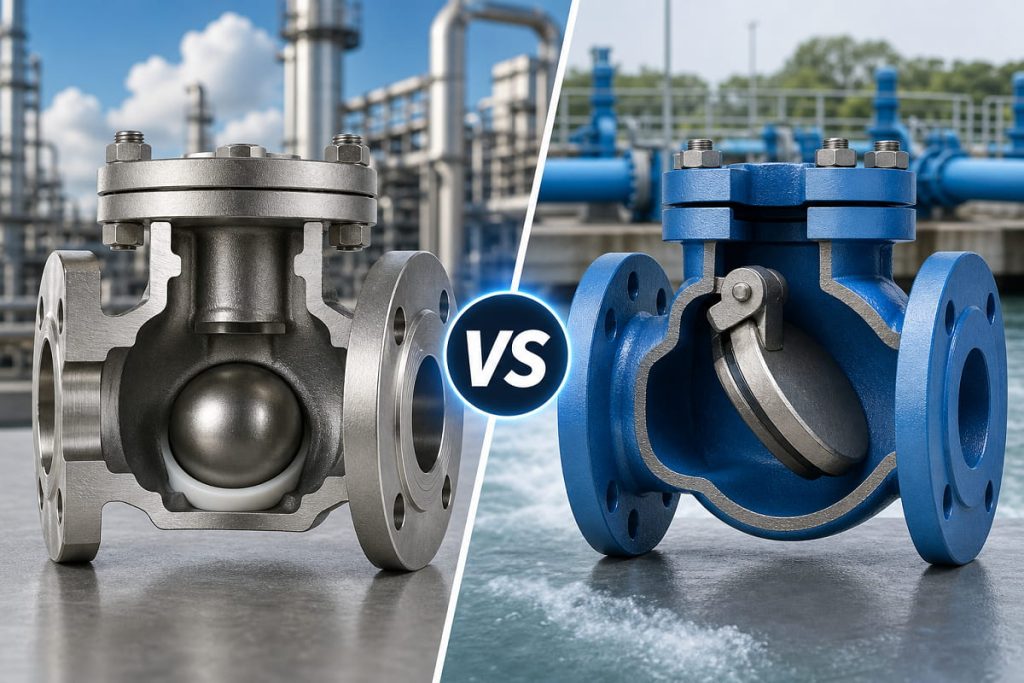
Ball check valves use a simple mechanism: a free-floating ball that moves with the flow.
When fluid moves forward, it pushes the ball off its seat. The ball lifts, and fluid passes through. When flow stops or reverses, gravity (or a spring) drops the ball back down. That creates a tight seal that prevents backflow.
Pro Tip: The ball is usually made of stainless steel, PTFE, or rubber-coated metal. Material choice matters more than you think—especially if you’re dealing with corrosive fluids or high temperatures.
Here’s what I personally recommend paying attention to:
- Cracking pressure: Ball check valves need enough forward pressure to lift the ball. If your pump can’t generate that pressure, the valve won’t open.
- Response time: These things close FAST. The ball snaps shut the moment flow stops. That’s great for preventing water hammer.
- Self-cleaning action: As the ball rotates, it wipes debris off the sealing surface. This is a HUGE advantage in dirty fluid applications.
How Swing Check Valves Work
Swing check valves operate on a totally different principle.
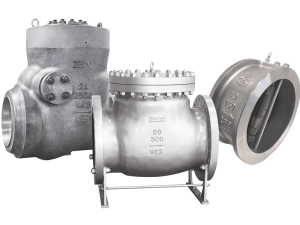
Instead of a ball, they use a hinged disc (flapper) that swings open when fluid flows forward. When flow stops, the disc swings back down and seals against the seat.
Think of it like a one-way door. Simple, right?
But here’s the catch:
- Flow restriction: When fully open, the disc swings completely out of the way. That means minimal pressure drop. Great for high-flow systems.
- Closing speed: Swing check valves close slower than ball check valves. The disc relies on gravity and reverse flow to seal. That delay can cause disc slam and water hammer.
- Installation matters: These valves work best in horizontal pipes. Install them vertically with downward flow, and the disc might not close properly.
Ball Check Valve vs Swing Check Valve: Key Differences
Let’s compare these two head-to-head. I’ve broken down the most important differences into a simple table:
| Feature | Ball Check Valve | Swing Check Valve |
|---|---|---|
| Mechanism | Free-floating ball | Hinged disc (flapper) |
| Pressure drop | Higher (ball stays in flow path) | Lower (disc swings out of way) |
| Response time | Instantaneous | Slower (gravity-assisted) |
| Water hammer risk | Low | High (disc slam) |
| Installation versatility | Any orientation | Horizontal preferred |
| Maintenance | Low (few moving parts) | Higher (hinge wear over time) |
| Best for pipe size | Small (¼” to 4″) | Large (2″ to 48″+) |
| Cost (small sizes) | More expensive | Less expensive |
When to Choose a Ball Check Valve
Ball check valves shine in specific scenarios. Here’s where I’d recommend them:
1. Low-Pressure Systems
If your system runs at low pressure (under 1,000 psi), ball check valves are your best bet. The ball lifts easily, and the spring-assisted closure prevents backflow without requiring high differential pressure.
2. Tight Spaces
Ball check valves are compact. Really compact. You can fit them into tight spots where swing check valves won’t work. Think under-sink plumbing, medical devices, or lab equipment.
3. Viscous or Dirty Fluids
This is where ball check valves really stand out. The self-cleaning action keeps the ball free from debris. I’ve seen them perform flawlessly in:
- Slurry handling
- Food processing lines
- Wastewater systems
- Chemical processing
4. Vertical Pipes
Need to install a check valve vertically? Go with a ball check valve. The spring mechanism ensures proper sealing regardless of orientation. Swing check valves won’t close reliably in vertical-downward flow.
5. Quick Response Required
Ball check valves close instantly. That rapid response prevents even a tiny amount of backflow. Critical for systems where contamination is a concern.
When to Choose a Swing Check Valve
Swing check valves dominate in large-scale, high-flow applications. Here’s when they’re the right call:
1. Large-Diameter Pipes
Got a 12″ or 24″ pipeline? Swing check valves are the go-to choice. They’re significantly cheaper than ball check valves in larger sizes, and the flow capacity is unmatched.
2. High-Flow Systems
Swing check valves create almost no flow restriction when fully open. The disc swings completely out of the flow path. That means lower energy costs and less strain on your pumps.
3. Municipal Water Mains
Fire sprinkler systems, city water distribution lines, industrial pipelines—these all rely on swing check valves. They handle high pressure (up to 5,000 psi) and provide reliable backflow prevention.
4. Budget-Conscious Projects
If you’re working on a large-scale project with tight budgets, swing check valves save serious money. The cost difference grows as pipe sizes increase.
5. Steady, Continuous Flow
Swing check valves work best when flow is consistent. The disc opens fully and stays open. No fluttering, no wear on the hinge.
Pros and Cons: Ball Check Valve
Pros:
- Rapid closure reduces water hammer
- Self-cleaning action
- Works in any orientation
- Low maintenance
- Excellent for dirty or viscous fluids
Cons:
- Higher pressure drop
- More expensive in large sizes
- Ball can wear over time in abrasive applications
- Not ideal for very high-pressure systems
Pros and Cons: Swing Check Valve
Pros:
- Minimal pressure drop
- Cost-effective for large diameters
- Handles high pressure
- Simple, reliable design
- Excellent flow capacity
Cons:
- Slow closure causes water hammer
- Limited installation orientation
- Hinge and disc wear over time
- Not ideal for dirty fluids
Common Questions (Answered)
Q: Can I use a ball check valve instead of a swing check valve?
Only if your system fits the size and pressure requirements. For small pipes (under 4″) with low pressure, ball check valves work great. For large industrial pipelines, stick with swing check valves.
Q: Which valve is more durable?
Ball check valves tend to last longer in corrosive environments. The ball has no hinges or pins to wear out. Swing check valves may need hinge repairs after 5-7 years in harsh conditions.
Q: How do I stop water hammer?
Water hammer is caused by sudden flow reversal. Ball check valves close faster, reducing the risk. For swing check valves, you can add lever and spring mechanisms to speed up closure.
Q: What about cracking pressure?
Ball check valves typically need higher cracking pressure due to the spring mechanism. Swing check valves open with minimal forward flow.
Case Study: Real-World Application
Earlier this year, I worked with a food processing plant that had a recurring backflow problem in their syrup lines. They were using swing check valves, but the viscous syrup was causing the disc to stick. The result? Contaminated product and costly downtime.
We swapped them out for 316L stainless steel ball check valves. The self-cleaning ball action eliminated the sticking problem. The rapid closure prevented backflow completely. Within two months, they’d saved enough in reduced downtime to pay for the valve upgrade.
Bottom line? The right valve choice can save you thousands.
Final Thoughts
Choosing between a ball check valve and a swing check valve comes down to three things:
- 1. Your system’s pressure and flow requirements
- 2. The type of fluid you’re moving
- 3. Your installation constraints
If you need fast response, compact size, and dirty-fluid handling, go with a ball check valve. If you need high flow capacity, large pipe sizes, and cost-effectiveness, choose a swing check valve.
And remember: always consult your system specifications before making the final call. The wrong valve can cost you more than the valve itself.
So there you have it—the complete breakdown of ball check valve vs swing check valve. Hope this helps you make the right choice for your system.