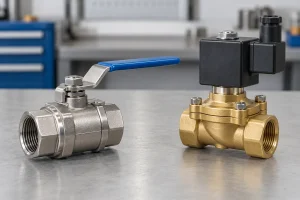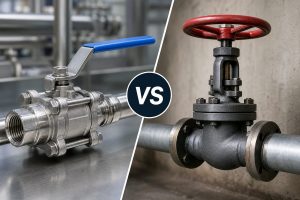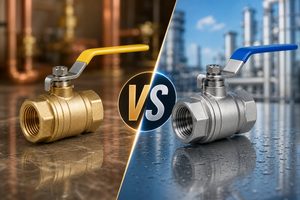
The choice in ball valve vs solenoid valve comes down to the job: a ball valve suits low-restriction flow and dependable isolation, especially when it stays in one position for hours. A solenoid valve suits compact, fast electrical switching of a compatible fluid within its rated operating range.
| Selection factor | Ball valve | Solenoid valve |
|---|---|---|
| Operating mechanism | A bored ball rotates 90 degrees. | An electromagnetic coil moves an internal mechanism, directly or through a pilot stage. |
| Actuation | Manual, electric, pneumatic, or hydraulic. | Electrical; some designs also use fluid pressure. |
| Switching speed | Depends on the actuator; electric models often take seconds or longer. | Many designs switch quickly; check opening and closing times separately. |
| Flow capacity | Full-port designs provide a relatively unobstructed flow path. | Capacity depends on the orifice and internal passages; compare Cv or Kv. |
| Low-pressure operation | Does not need line pressure to rotate the ball. | Direct-acting and specified zero-differential models can operate without a pressure differential. |
| Holding power | Some electric actuators draw little or no holding power; others have standby loads. | Conventional coils need power while energized; latching designs use pulses. |
| Power-loss position | Depends on the actuator and its fail-return arrangement. | Depends on whether the valve is normally closed, normally open, or latching. |
| Debris sensitivity | Full-port designs may suit some contaminated fluids, but seats and cavities remain vulnerable. | Small pilot passages and sealing surfaces can be sensitive to contamination. |
A motorized ball valve and a pneumatically actuated ball valve can behave very differently, even when they share the same valve body. The actuator determines how the valve moves and helps determine what happens when its power supply fails.
For ordinary on/off fluid control, use the examples below to narrow your options, then check the valve and actuator datasheets. The calculations and application scenarios are illustrative, not field-test results.
How ball valves and solenoid valves work
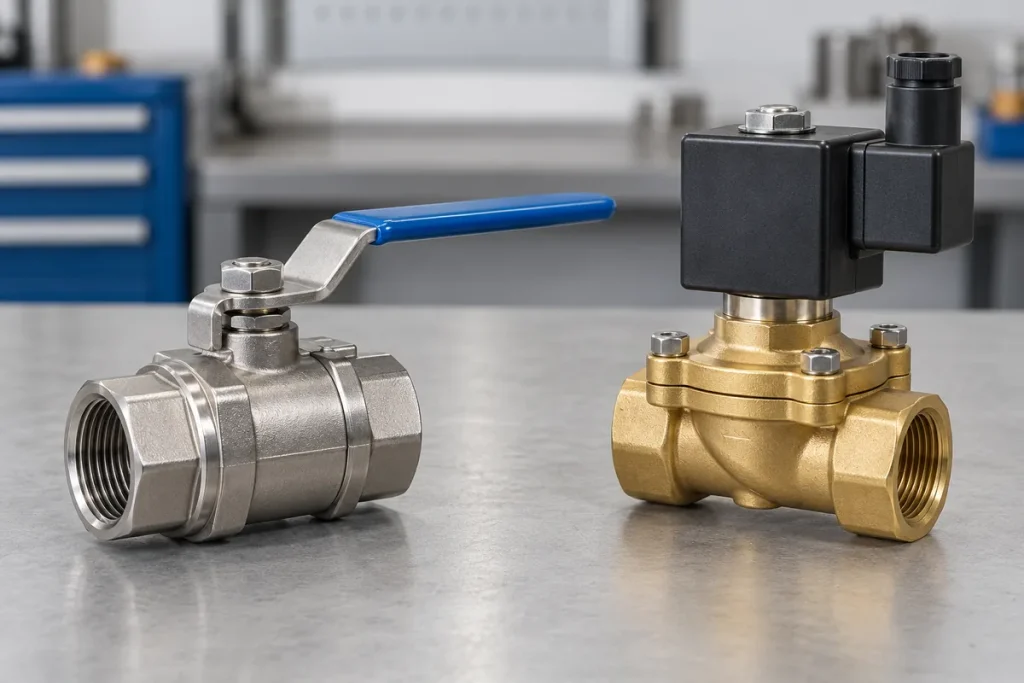
A ball valve controls flow by rotating a ball with a hole through it; a solenoid valve uses an electromagnetic mechanism. The actuator and internal design determine how quickly each valve moves, how much fluid it passes, and the conditions it can handle.
Ball valves: a quarter-turn flow path
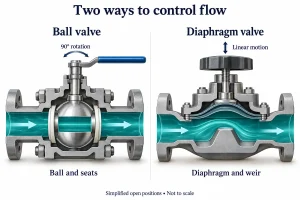
A ball valve opens when the hole through its ball aligns with the pipe and closes when the ball turns 90 degrees. A handle or actuator supplies the turning force.
You’ll commonly see two bore configurations:
- Full port: The opening is approximately the size of the connected pipe bore, helping limit pressure loss. ZECO’s guide to full-port ball valves explains this bore configuration.
- Reduced port: The opening is smaller, which can reduce cost and size while increasing flow restriction.
Both configurations cause some pressure loss. Check the published flow coefficient to see whether the valve can pass the flow you need; the connection size alone won’t tell you.
An electric ball valve uses a motor, while a pneumatic actuator uses compressed air. Their speed, duty limits, and behavior during a supply failure can differ substantially.
Solenoid valves: direct or pressure-assisted operation
A solenoid valve uses a magnetic field to move a plunger or another internal element. In a direct-acting design, that movement operates the flow opening directly; in a pilot-operated design, it controls a small passage that helps move the main sealing element.
Bürkert distinguishes direct-acting and servo-assisted solenoid valves by how they use magnetic force and fluid pressure. Many pilot-operated valves need a minimum inlet-to-outlet pressure difference to work correctly.
A valve can fit the pipe and have the right voltage, yet fail to open properly on a gravity-fed tank. A direct-acting or appropriately specified zero-differential design can solve that problem, provided it has enough flow capacity.
Compare the specifications that affect your system
Start with flow capacity, pressure differential, response time, power use, and failure position. These specifications tell you whether a particular valve will do the job. Claims that one valve family is always faster, stronger, or more reliable leave out too much.
Flow rate and pressure drop
A full-port ball valve often suits applications where preserving flow and limiting pressure drop are priorities. For either valve type, use Cv or Kv to compare actual flow capacity.
These coefficients describe how much fluid a valve can pass under defined conditions. They are not interchangeable numbers, so keep the units consistent.
For a simplified, non-cavitating water-flow example:
Pressure drop in psi ≈ (flow in US gallons per minute ÷ Cv)².
Suppose your system needs 10 US gallons per minute:
- A valve with Cv = 5 produces approximately 4 psi of pressure drop.
- A valve with Cv = 10 produces approximately 1 psi of pressure drop.
These calculated values illustrate the difference; they aren’t ratings for a particular product. Two valves with identical pipe connections can have very different flow capacities.
Use a manufacturer’s sizing method for the actual fluid and conditions. Swagelok’s Cv calculator accounts for parameters including fluid, inlet and outlet pressure, and temperature. Gas, viscous-liquid, and cavitating service need more than the simple water example above.
Operating pressure and minimum differential
Check both the pressure rating and the required pressure difference across the valve. A valve can be rated for your maximum inlet pressure and still fail to operate when the inlet and outlet pressures are too close together.
Consider a tank that gradually empties. A pilot-operated solenoid valve might work while the tank is full, then become unreliable as the pressure difference falls below its specified minimum.
A motorized ball valve does not need that differential to turn. It still needs enough actuator torque to operate against the actual pressure, seat friction, and process conditions.
Both families include specialized high-pressure products, so a ball valve doesn’t automatically have the higher rating. Compare the exact pressure-temperature ratings, allowable differential pressure, and flow-direction restrictions.
Switching speed and water hammer
Many solenoid valves suit rapid switching, while electric ball-valve travel times vary widely. The fastest choice is useful only if your process and piping can tolerate it.
Belimo’s LR24A-SR ball-valve actuator datasheet, for example, lists a 90-second running time for 90-degree travel. You couldn’t use that actuator for a process that needs a complete stroke in a few seconds.
In a liquid line, rapid flow changes can create water hammer, a pressure surge that stresses the piping and components. A fast-closing solenoid can contribute to it. So can a quickly operated manual or pneumatic ball valve.
The University of Florida’s guidance on water hammer in irrigation systems explains how sudden flow changes create pressure waves. It recommends choosing pipe that can withstand operating pressure plus the expected surge, with temperature effects taken into account.
Slower closure can help, but total actuator travel time does not tell you exactly how flow changes near shutoff. Bürkert’s water-hammer guidance also describes solenoid-valve designs that use gentle diaphragm closure to reduce the problem.
For a surge-sensitive installation, review the closing behavior, flow velocity, pipe length, and surge-control provisions together.
Power consumption and holding time
Conventional solenoid valves usually need continuous electrical power in their energized position. Some motorized ball valves stop drawing motor power after reaching the commanded position, although controls, heaters, or other components may still consume electricity.
Hunter’s DC-latching solenoid guidance explains that a battery-operated controller sends a brief pulse to operate the solenoid. A latching design therefore does not follow the usual continuous-coil-power rule.
The Belimo actuator cited above lists 0.4 W of consumption at rest, which belongs in the energy calculation even when the motor isn’t turning.
A hypothetical 8 W coil energized continuously for a 24-hour day uses:
8 × 24 ÷ 1,000 = 0.192 kWh per day.
Multiply that by your actual operating days and electricity rate. Then include switching energy and standby loads when comparing alternatives. For pneumatic systems, include the cost of supplying compressed air.
Power-loss position and fail-safe operation
Specify whether flow must stop, continue, or remain unchanged when power fails. The valve name alone does not guarantee that behavior.
A conventional normally closed solenoid valve is designed to close when de-energized; a normally open version is designed to open. Both still need to operate within their specified conditions, and contamination or mechanical faults can prevent the intended action.
A latching solenoid may remain in its last state. A standard electric actuator may also stay where it is when power disappears.
If a ball valve must move to a defined failure position, specify an appropriate spring-return or stored-energy actuator. Check the complete assembly’s behavior during electrical failure, control-signal loss, and loss of compressed air, where applicable.
For a safety shutdown, verify the required approvals and system-level performance. “Normally closed” by itself is not a safety certification.
Match the valve to the fluid and maintenance plan
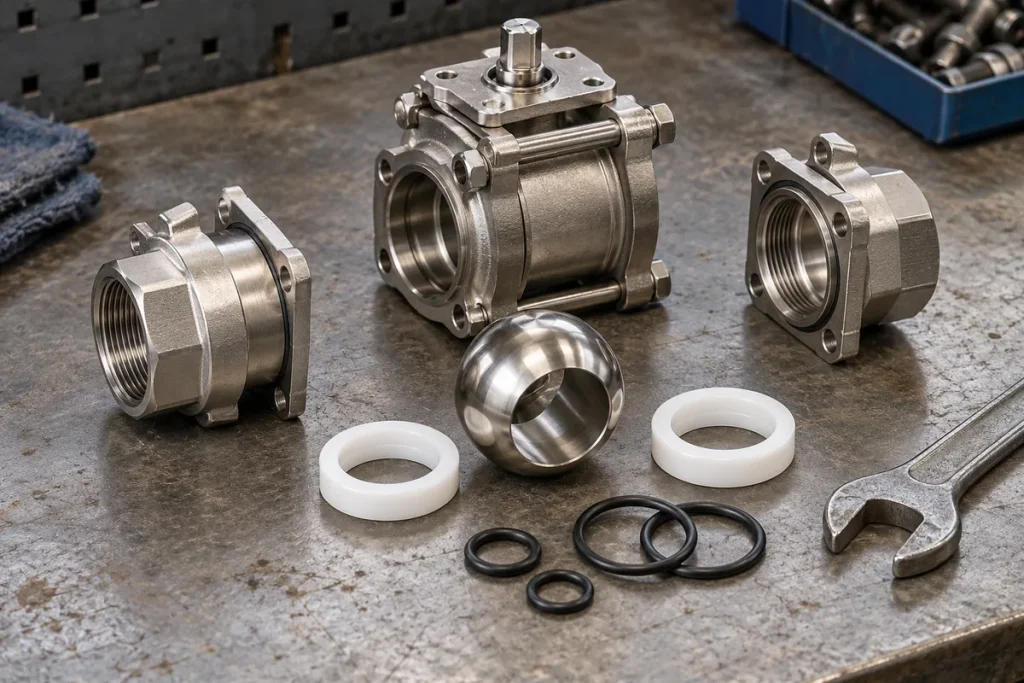
Chemical compatibility, contamination, temperature, and maintenance access can determine service life more strongly than the choice between ball and solenoid mechanisms. Check every wetted component, including seats, seals, diaphragms, and internal metals.
A stainless steel body does not automatically make a valve suitable for every chemical. EPDM, NBR, FKM, and PTFE have different limits, and compatibility can change with concentration and temperature.
ZECO’s overview of ball-valve seat materials is a useful starting point for comparing soft-seat options. Confirm the selected grade against the complete valve’s pressure-temperature rating and your fluid’s chemistry.
Dirty water creates a different challenge. Small solenoid pilot passages can become obstructed, while particles on a sealing surface can cause leakage. A suitable strainer may help, but it introduces its own pressure drop and cleaning requirement.
Full-port ball valves can handle some fluids containing particles, but abrasive solids can damage seats and material can collect in body cavities. They still need a maintenance plan, even if a product description calls them “self-cleaning.”
For slurries, sticky fluids, or hygienic processing, ask for a design specifically intended for that service. A general-purpose valve may be unsuitable regardless of its operating mechanism.
I’d check maintenance access before buying. Leave enough room to service the coil, actuator, seals, and nearby strainer without dismantling a large section of pipe.
Choose for the way your system runs
A compact solenoid often suits frequent switching of clean fluid, while a full-port actuated ball valve often suits isolation with limited pressure loss. How long the valve stays open and how often it moves can change the choice.
A small machine that switches frequently
A solenoid valve is a sensible starting point when a machine needs rapid, repeated on/off control of clean air or a compatible liquid. Confirm the response time, rated cycling capability, coil duty, and available pressure differential.
Suppose a machine needs short bursts of air. A compact directional solenoid valve can fit the timing requirement and route or exhaust air as needed.
For liquid dispensing, fast switching alone does not guarantee an accurate dose. Pressure variation, flow rate, and opening and closing delays also affect the delivered volume.
A water line that stays open for hours
A motorized full-port ball valve is worth considering when a water line remains open for long periods and pressure loss matters. Specify potable-water approval if required, suitable enclosure protection, and the desired power-loss position.
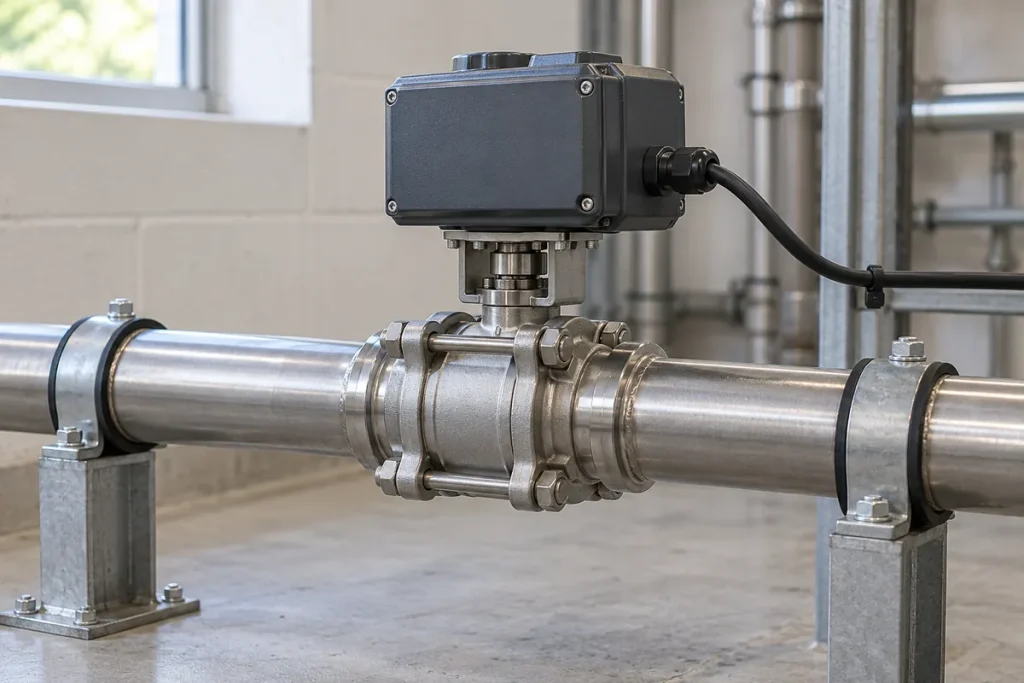
For U.S. drinking-water service, check the EPA’s lead-free plumbing requirements and the product’s certification. For covered pipes, fittings, and fixtures, “lead free” means a weighted average lead content of no more than 0.25% across wetted surfaces. This requirement is separate from the valve’s pressure rating; it doesn’t apply in the same way to exempt products used exclusively for nonpotable service.
For irrigation, purpose-built solenoid diaphragm valves also deserve consideration. They can offer compatible controls and appropriate flow capacity, while latching models suit some battery-powered installations.
Check the control interface, too. An irrigation controller’s output may not directly operate a motorized actuator, even if their nominal voltages look similar.
A process that diverts flow every 10 seconds
Frequent diversion requires checking the port arrangement, transition behavior, and actuator duty before choosing either valve family. A three-way connection by itself does not tell you how the flow changes between outlets.
If the command changes every 10 seconds, the assembly makes 360 transitions per hour. An actuator that takes several seconds per movement may spend a substantial share of that hour running.
Check whether the valve briefly blocks both outlets or connects them during travel. That matters if the pump cannot tolerate a blocked discharge or the two streams must remain separated.
A suitable solenoid valve or pneumatic ball-valve assembly may meet the requirement. An electric actuator can also work if its speed, cycle rating, and duty limits support the application.
What to give your supplier before ordering
Give the supplier the operating conditions and required control behavior so they can match the valve and actuator. Include the following details along with the pipe size and voltage:
- Identify the liquid or gas, its concentration and viscosity, and any expected contamination.
- Include fluid and ambient temperature limits.
- Provide minimum and maximum inlet pressure, outlet pressure, and expected transients.
- State the required flow rate and acceptable pressure drop.
- Define on/off, diversion, or modulating control, plus required opening and closing times.
- Specify transitions per hour, operating hours, and extended holding periods.
- State the required position after power, signal, or air-supply loss.
- Confirm connections, flow direction, orientation, voltage, control interface, and service space.
- Identify applicable drinking-water, gas, hazardous-area, food-contact, or other approval requirements.
Compare installed cost once you have suitable options. Include wiring, controls, filtration, air supply, energy, spare parts, and maintenance labor. A cheaper valve can cost more to run and service if it’s poorly matched to the duty.
Common questions about valve selection
You can replace one valve type with the other in some systems, but the replacement must meet the same flow, pressure, control, and failure requirements. Service life and throttling capability also depend on the particular design.
Can a solenoid valve replace a ball valve?
Yes, if it meets the required flow capacity, pressure range, fluid compatibility, control function, and failure behavior. Matching the thread size is not enough.
Also consider maintenance isolation. An electrically commanded valve may not provide the manual, lockable isolation your procedures require.
Which valve lasts longer?
Neither valve family has a universal service-life advantage. Contamination, temperature, pressure, switching frequency, installation, and maintenance all influence the outcome.
Ask for cycle-life information under comparable conditions. For an automated ball valve, evaluate the actuator and valve body together; either can limit the assembly’s useful life.
Can these valves regulate flow?
Specialized versions can regulate flow, but ordinary on/off models should not be assumed suitable for continuous throttling. A V-port ball valve with an appropriate modulating actuator or a proportional solenoid valve may fit that task.
Confirm controllability, pressure-drop limits, and the required flow range. Simply leaving a standard ball valve partly open does not make it a properly sized control valve.
Can a ball valve and a solenoid valve work together?
Yes. A solenoid valve can route compressed air to a pneumatic actuator that turns a ball valve.
This arrangement combines electrical control with pneumatic actuation. It still requires coordinated sizing, suitable air quality, and a defined failure position for the complete assembly.
Choose from your operating conditions
Start with a solenoid valve for compact, rapid switching of a compatible fluid; start with an actuated ball valve when flow capacity, isolation, and long holding periods lead the requirements. Then confirm the actual product specifications against your system.
I’d write down the required flow, available pressure differential, switching frequency, and desired failure position before comparing prices. Use those requirements to rule out unsuitable assemblies, then check that you can service the remaining options in the space available.
Keep that specification beside the product datasheets when you make the final comparison.