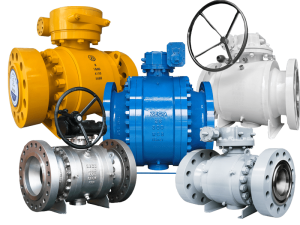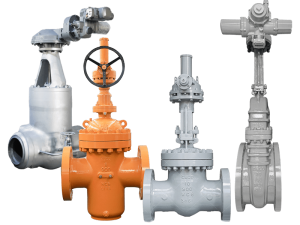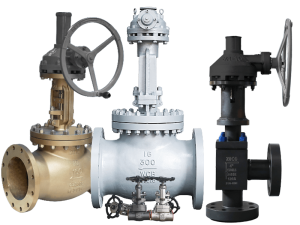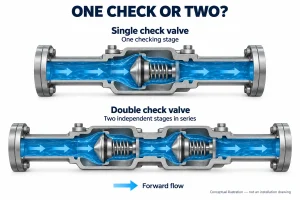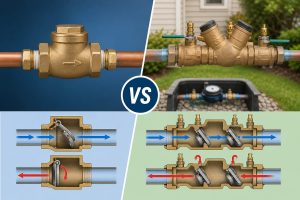
The main difference in single check valve vs double check valve is that a single check valve has one checking mechanism, while a double check valve has two independent checks in series to provide a backup barrier against reverse flow. Choose a single check for suitable equipment protection, or an approved double check valve assembly for a potable-water connection classified as a non-health hazard where local rules permit it; health-hazard connections require a different level of protection.
| Feature | Single check valve | Double check valve assembly (DCVA) |
|---|---|---|
| Checking stages | One | Two independent checks in series |
| Backup if one check leaks | No second checking stage | The other check can still prevent reverse flow |
| Typical purpose | Control reverse flow in suitable pump and process piping | Protect approved non-health-hazard water connections |
| Field testing | Ordinary models usually lack dedicated test connections | Includes test cocks and isolation valves for testing |
| Health-hazard water protection | Not a substitute for the required backflow preventer | Not suitable where health-hazard protection is required |
| Pressure loss | Depends on design, size, and flow | Depends on the complete assembly; compare flow curves |
| Cost and space | Usually lower cost and simpler installation | Usually higher cost, with testing and service space needed |
One naming detail matters before you order anything: a product sold as a “double check valve” is not automatically a testable DCVA. This guide uses common U.S. backflow terminology. Other countries classify devices and fluid risks differently, so confirm the exact approval required for your location.
What Does a Single Check Valve Do?
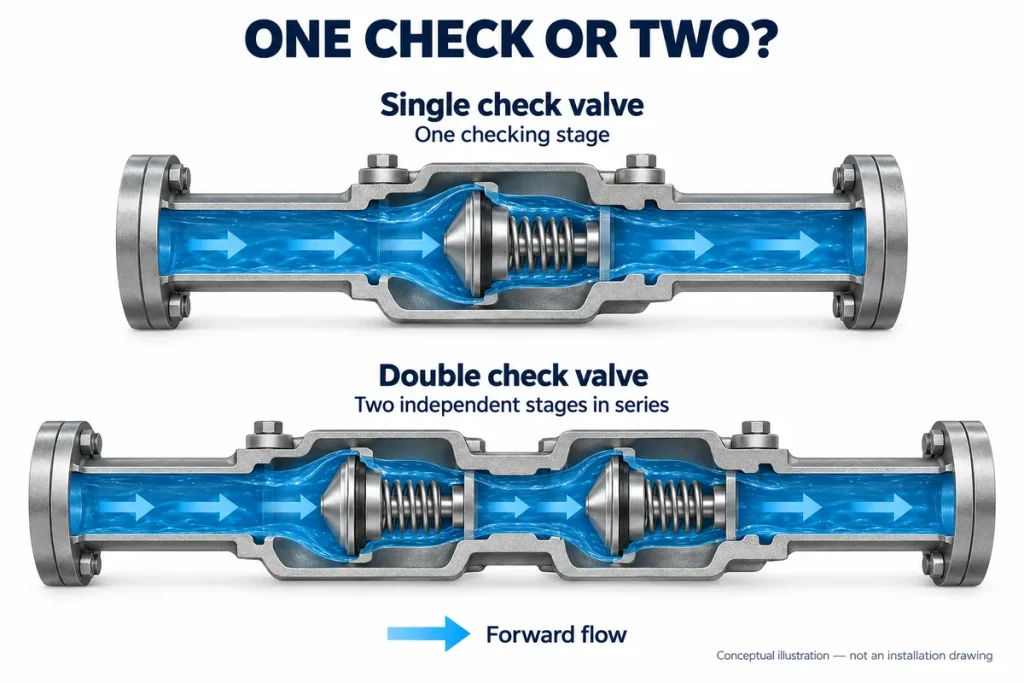
A single check valve automatically allows forward flow and closes to resist reverse flow. It uses one checking stage, operated by the pressure difference across the valve, with gravity or a spring assisting closure depending on the design.
Picture a sump pump lifting water through a discharge pipe. When the pump stops, water in that pipe can fall back toward the sump. A suitable check valve helps prevent that return flow and the extra pump cycling it can cause.
Simple job. Useful component.
But its performance depends on the application. A check valve selected for clean water may be unsuitable for solids, hot fluids, or a rapidly cycling pump.
How the Main Check Valve Designs Work
Swing, lift, spring-assisted, and ball check valves use different moving parts to perform the same basic job: open for forward flow and seat against reverse flow.
- Swing check: A hinged disc moves away from its seat as fluid passes through.
- Lift or piston check: A guided closure element lifts off a seat and returns when the opening force falls.
- Spring-assisted check: A spring helps close the disc or poppet as forward flow decreases.
- Ball check: A ball moves away from its seat during forward flow and returns to block reverse flow.
These categories can overlap. A piston check, for example, can also be spring-assisted.
Installation orientation is model-specific. Never assume every lift check belongs in a vertical pipe or every spring check works in any position. Read the installation instructions for the actual model.
Where a Single Check Valve Falls Short
A single check valve has no second independent checking stage if its seat leaks or its moving element sticks. That makes its suitability depend on the consequences of failure.
A small piece of debris can hold the seal open. Wear, corrosion, or an unsuitable flow rate can also affect operation.
And normal forward flow tells you very little about reverse sealing. Water can pass through a valve that no longer closes properly.
A functioning pump is not proof of functioning backflow protection.
What Does a Double Check Valve Assembly Add?
A double check valve assembly adds a second independently acting check and the fittings needed to test the assembly in place. In the common U.S. configuration, that means two spring-loaded checks, an upstream and downstream shutoff valve, and four test cocks.
Water follows this sequence:
Inlet → first check → second check → outlet.
If either check fails to seal, the other may still stop reverse flow. The assembly provides redundancy, while its test connections let a qualified tester assess the individual checks.
That backup has limits. The same dirty water, freeze damage, or neglected maintenance can affect both checks. Two barriers do not create a guarantee against failure.
For a concrete manufacturer example, Watts describes its Series 007 as intended for non-health-hazard cross-connections. It also identifies test cocks and replaceable seats among the product features.
Double Check, Dual Check, and Dual Plate Are Different Terms
A compact dual-check device, a testable DCVA, and a dual-plate industrial check valve are different products, even though their names sound similar.
A compact dual-check device contains two checks but may lack the test cocks and shutoff valves of a DCVA. Its permitted use depends on its listing and local requirements.
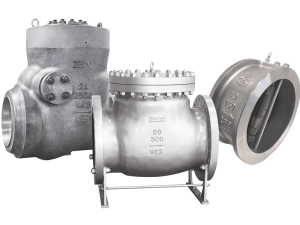
A dual-plate check valve has two semicircular plates that close across one flow passage. Those plates do not create two independent checking stages in series.
My recommendation: ask for the full product designation and approval documentation. Counting discs in a product photo is not a reliable selection method.
Which Backflow Risks Can a DCVA Address?
An approved DCVA can protect against both backpressure and backsiphonage in permitted non-health-hazard applications. Its suitability depends on the water hazard as well as the cause of reverse flow.
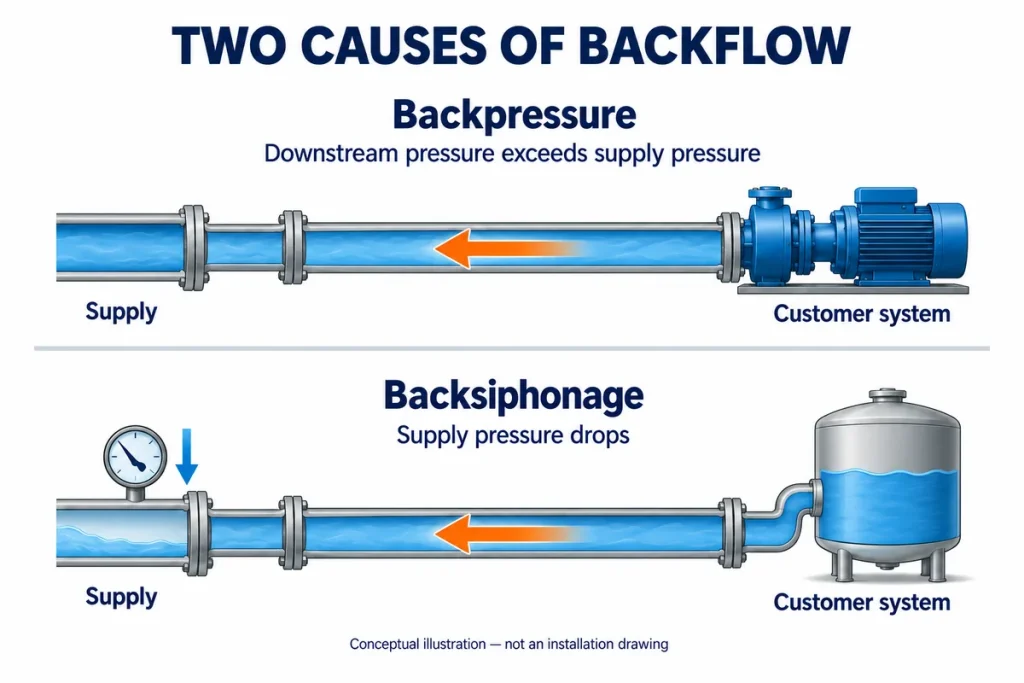
Backpressure occurs when pressure downstream exceeds the supply pressure. A pump or an elevated tank can create that condition.
Backsiphonage occurs when supply pressure drops and allows water to be drawn backward through a cross-connection. A water-main break is one possible trigger.
These are two ways backflow happens. Neither term tells you how dangerous the returning water would be.
Why Hazard Classification Comes First
The consequence of contamination determines the required protection. A non-health hazard can affect water’s aesthetic qualities; a health hazard can cause injury, poisoning, or disease.
Washington State provides a clear, verifiable example. Its cross-connection rule, Table 12, includes DCVAs among permitted methods for low-hazard premises isolation. For high-health-hazard connections, it specifies options such as an approved air gap or reduced-pressure assembly.
Those are Washington requirements, not a worldwide rulebook. Your water supplier and local code authority determine what is acceptable at your connection.
Avoid a vague label such as “moderate risk” unless the governing rules define it. Get the actual classification.
When You Need an RP Assembly or Air Gap
A health-hazard connection generally needs protection beyond a DCVA, such as an approved reduced-pressure assembly or air gap selected for the application. Some severe hazards require physical separation through an air gap.
A reduced-pressure assembly, often called an RP or RPZ, includes two checks and a differential-pressure relief valve between them. The relief valve can discharge water when conditions within the assembly require it.
Watts identifies its Series 009 RP assembly for health-hazard cross-connections involving backpressure or backsiphonage.
That discharge capability also affects installation. Drainage, clearance, and flood protection need attention. Adding a second ordinary check valve does not reproduce an RP assembly’s design or approval.
Double Check Valve vs Single Check Valve: Compare Real Costs
Compare purchase price, pressure loss, testing, repairs, and the cost of an unsuitable installation when choosing between a single check and a double-check assembly. A lower-priced valve can become expensive if it fails inspection or restricts the required flow.
Start with these four factors.
1. Compare Pressure Loss at the Same Flow Rate
Compare published pressure-loss curves at your design flow, using the actual valve sizes and models under consideration. There is no universal pressure-drop figure for either category.
A double-check assembly adds components and flow resistance. But it does not necessarily lose exactly twice as much pressure as a particular single check valve.
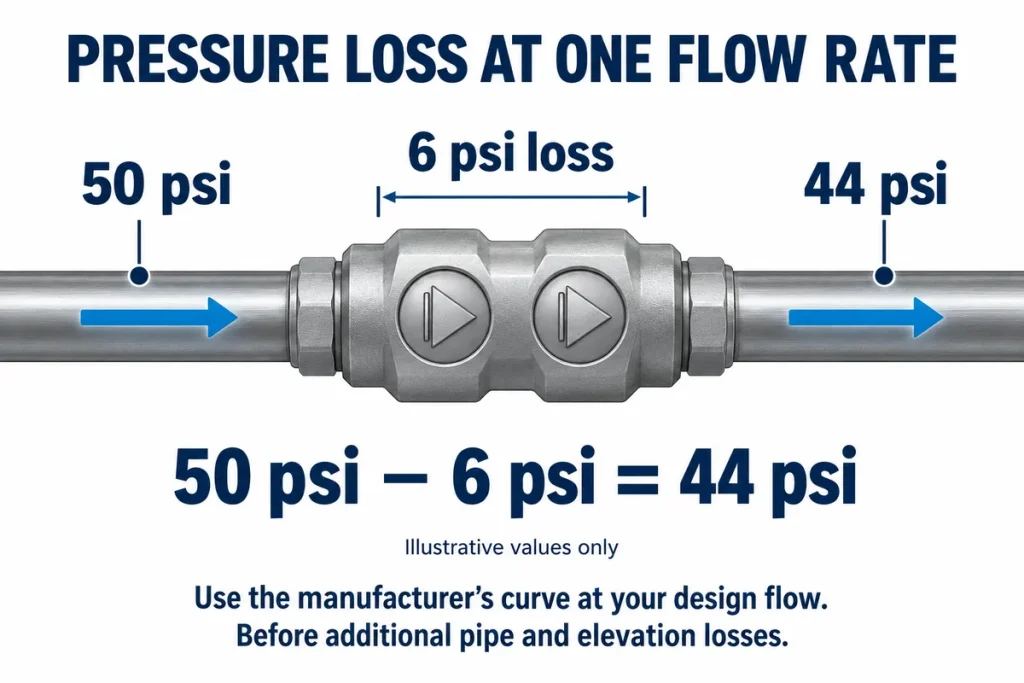
For an illustrative calculation, assume 50 psi is available at the assembly inlet while the system is flowing. If the selected assembly loses 6 psi at that flow, approximately 44 psi remains immediately downstream, before further pipe losses and elevation changes.
50 psi − 6 psi = 44 psi.
These are example numbers, not product ratings. Use the manufacturer’s curve and the system’s actual operating conditions for your calculation.
2. Separate Cracking Pressure From Operating Loss
Cracking pressure is the differential pressure needed to begin opening a check valve. It is different from the pressure loss across the valve at a particular operating flow.
That distinction matters in low-pressure systems. A valve can begin opening and still impose more resistance than the application can tolerate at its required flow.
Ask for both values where relevant. A single pressure number on a sales page rarely answers the whole question.
3. Include Testing and Service Access
A DCVA’s installed cost includes access for testing and repair, plus the required testing program. The cheapest physical location may be costly to service.
Leave space to operate the shutoffs, connect test equipment, and remove internal components. Account for freeze protection and avoid locations where the assembly can become submerged.
A valve hidden behind permanent construction creates a maintenance problem before its first test.
4. Match Materials and Ratings to the Service
The body, seals, springs, pressure rating, and temperature rating must suit the fluid and operating conditions. For drinking-water applications, also verify the required potable-water and lead-content approvals.
“Stainless steel” or “bronze” alone does not establish suitability. Seal compatibility, product listing, and maximum operating conditions still matter.
For industrial service, remember that a potable-water DCVA is not automatically suitable for steam, gas, chemicals, or high temperatures.
Which Valve Fits Your Application?
Choose the valve by the job it must perform and the consequences of reverse flow. The examples below are selection scenarios, not site approvals or reported field case studies.
Pump Discharge and Sump Systems
A suitable single check valve often handles reverse-flow control on a pump discharge where a separate potable-water cross-connection requirement does not apply.
For example, a sump discharge needs a valve compatible with the water, possible solids, flow rate, and installation position. A commercial backflow assembly is not automatically a useful upgrade for that duty.
Also evaluate closure behavior. A poorly matched check valve can slam or chatter; simply choosing a slower-closing valve is not a universal cure for water hammer.
For industrial pump service, a spring-assisted axial check valve is one design worth evaluating for rapid response as forward flow decreases. Confirm its dynamic performance against the actual system conditions.
Fire Sprinkler Connections
Some fire sprinkler connections use a DCVA or double check detector assembly when the authority classifies the connection as an appropriate low hazard. Chemical additives or an auxiliary water source can change the required protection.
For example, Washington’s rule distinguishes ordinary qualifying fire connections from systems with chemical addition or an unapproved auxiliary supply. The latter require reduced-pressure protection under that rule.
The added pressure loss also belongs in the fire system’s hydraulic assessment. A substitution needs approval and a performance check.
Irrigation and Chemical Injection
Irrigation backflow protection depends on local rules, contamination exposure, and whether backpressure can occur. Never assume every lawn irrigation system qualifies for a DCVA.
Fertilizer or pesticide injection is a particularly important detail to disclose. It can create a health hazard requiring a different protection method.
Some irrigation arrangements may permit a vacuum breaker under specified installation conditions. A vacuum breaker addresses backsiphonage and is not a general solution for backpressure.
Give the designer the complete system description before choosing hardware.
How to Choose the Right Valve in Five Steps
Start with the hazard classification, then verify the approved device, hydraulic performance, installation conditions, and maintenance requirements. This sequence helps prevent expensive substitutions after purchase.
- Define the duty. Record the fluid, minimum and maximum flow, pressure, temperature, and what happens if reverse flow occurs.
- Confirm the required protection. For potable-water connections, ask the water supplier or code authority to identify the hazard classification and acceptable protection method.
- Verify the exact product. Check the model, size, listing, and permitted orientation against the applicable approval requirements.
- Check system performance. Use published flow data to evaluate pressure loss, opening behavior, and compatibility with the pump or downstream equipment.
- Plan the full installation. Include access, environmental protection, commissioning, test frequency, repair parts, and records.
Washington’s Department of Health guidance illustrates why checking the approved assembly list matters. An approval applies to the accepted assembly, not simply to the idea of using two checks.
Before requesting a quote, gather those five sets of information. A supplier can give a much more useful recommendation with an operating flow and hazard classification than with pipe diameter alone.
Installation and Maintenance Mistakes to Avoid
Incorrect orientation, inaccessible test points, debris, freezing, and missed testing can undermine a correctly selected valve. Follow the model’s installation instructions and the authority’s requirements throughout its service life.
Keep these points on your installation checklist:
- Match the flow arrow. Confirm both flow direction and the approved mounting position.
- Flush as instructed. Construction debris can damage or obstruct a seat. Add a strainer only where the manufacturer and system requirements permit it.
- Provide service clearance. Shutoff valves, covers, and test cocks must remain accessible.
- Protect against freezing and flooding. A check valve does not prevent trapped water from freezing.
- Assess thermal expansion. Preventing reverse flow can create a closed water system that needs an appropriate expansion-control arrangement.
- Record testing and repairs. Retain the model, serial number, location, results, and corrective work.
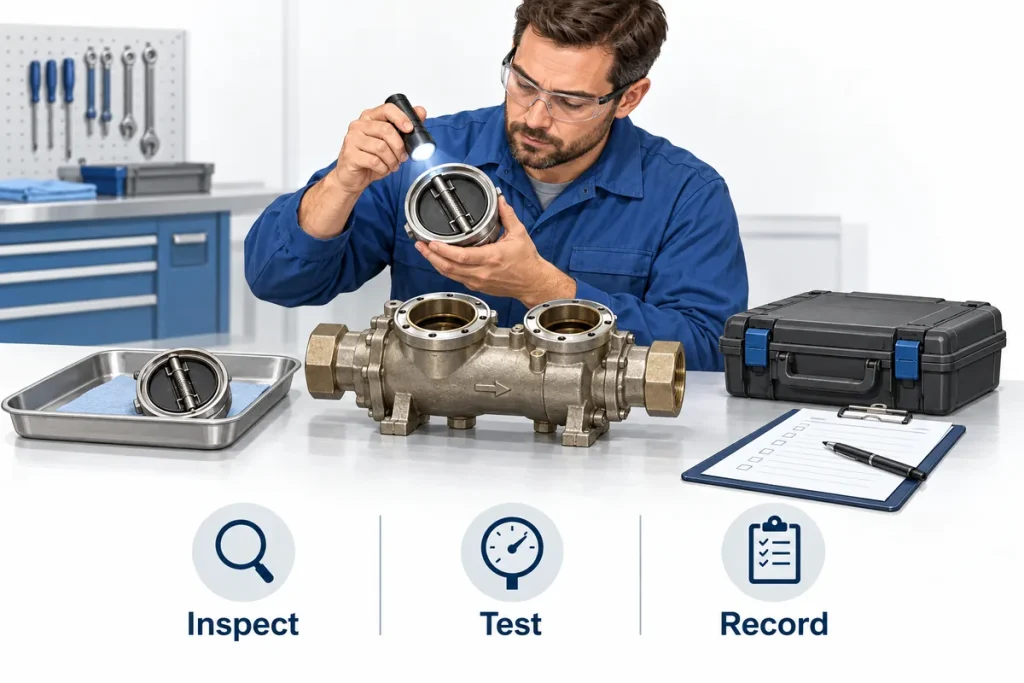
For a specific regulatory example, Washington requires covered backflow assemblies to be tested on installation and after events including repair or relocation, then annually unless more frequent testing is required. Use your own authority’s schedule and a qualified tester meeting its requirements.
If an assembly fails, arrange the required repair and retest. Normal water pressure or an absence of visible leakage does not establish that both checks seal correctly.
Frequently Asked Questions
The most common questions concern substitution, testing, and whether two checks automatically provide the required protection. The answers depend on the complete device and its approved application.
Can I Install Two Single Check Valves Instead of a DCVA?
Two separate check valves in series do not automatically qualify as an approved DCVA. The assembly’s listing, shutoff valves, test connections, and accepted configuration matter.
Use the complete approved product when a DCVA is required. Obtain approval before proposing an alternative arrangement.
Does a Double Check Valve Stop Flow in Both Directions?
No. During normal operation, both checks open to allow forward flow and close to prevent reverse flow. “Double” refers to the two checking stages.
The assembly’s separate shutoff valves provide manual isolation for tasks such as testing and maintenance.
Is a Double Check Valve Better Than a Single Check?
A double-check assembly adds redundancy and testability, making it suitable for specific backflow-protection duties. A single check can still be the appropriate choice for a pump or process application.
Better means suitable for the required duty, operating conditions, and applicable rules.
Can I Tell Whether It Works by Looking at the Water?
No. Clear water, normal taste, and steady pressure do not prove that a backflow assembly is working. Some contaminants produce no obvious change, and a leaking check can still pass forward flow normally.
Use the required inspection and testing process to assess operation.
Choose the Protection Your System Actually Needs
Choose a single check for suitable one-way flow control, a DCVA for approved non-health-hazard backflow protection, and the required higher level of protection for health hazards. Then confirm the exact model’s approval, pressure loss, installation requirements, and testing schedule.
My practical recommendation is to settle the hazard classification before comparing prices. That one decision narrows the options and prevents buying a valve that cannot do the required job.
For industrial one-way-flow applications, use the check valve product range to compare available designs. For potable-water backflow protection, verify the separate assembly approval required by your authority.